Guide
Yoga for Anxiety: A Calm, Breath-Led Starting Point
When your mind is racing, a fast class is the last thing you need. Here's how slow, breath-led yoga and grounding shapes help calm the nervous system — and where to find that kind of class in LA.

When your mind is racing, the last thing that helps is being told to “just relax.” Anxiety isn’t a willpower problem, and you can’t muscle your way out of it. What you can do is give your body slow, repeatable signals that it’s safe to settle — and a calm, breath-led yoga practice is one of the gentlest ways to do exactly that.
This guide is the plain-English version. No mysticism, no promises it can’t keep, no pressure to bend yourself into a pretzel. Just how a slower practice works, which shapes tend to help, and how to find the right kind of class in LA.
Why slow yoga helps an anxious nervous system
Your nervous system has two broad gears. One revs you up — heart rate climbs, breath gets shallow, muscles brace. That gear is useful in real emergencies and exhausting when it’s stuck on. The other gear is the “rest and settle” mode, where your body slows down and feels safe.
Anxiety keeps you idling in the first gear. The point of a slow practice isn’t to force the second gear on — it’s to gently invite it. Long holds, soft movement, and a steady, unhurried breath all nudge your body toward settling. A fast, sweaty, music-pumping class can be wonderful for other reasons, but it tends to rev the same gear anxiety already has running hot.
So when you’re choosing a class for anxious days, the rule of thumb is simple: slower is usually better.
The breath does most of the work
If you take one thing from this guide, take this: the breath is the active ingredient.
Here’s the part that’s easy to miss. A slow inhale gently speeds the heart; a slow exhale gently slows it. So when you make your exhale longer than your inhale, you’re tilting your whole system toward calm — not as a metaphor, but mechanically.
You don’t need a class to try it. Right now, breathe in for a count of four, then out for a count of six. Do that five or six times. Notice the small drop in urgency. That’s the same lever a good slow-yoga class pulls for an hour: matching soft movement to a long, easy exhale until the settling becomes the default.
A simple breath to start with
- Breathe in through your nose for about four counts.
- Breathe out, slow and quiet, for about six.
- Let the exhale be the relaxed part — you’re not forcing air out, just letting it leave slowly.
- If counting stresses you, drop the numbers and simply make the out-breath longer than the in-breath.
This costs nothing and travels everywhere — your desk, your car, the moment before a hard conversation.
Grounding shapes that help you feel steady
When you’re anxious, being up and balancing on one foot can feel like more than you want to manage. Grounding shapes do the opposite: they bring you low, give your body a lot of contact with the floor or a prop, and let you stop holding yourself up. That sense of being held is the point.
A few that tend to help:
- Child’s pose — knees wide, forehead down, arms forward or by your sides. A natural “I can rest here” shape you can return to any time.
- Legs up the wall — lying on your back with your legs resting up a wall. Quiet, passive, and a favorite for winding down.
- Supported forward fold — sitting and folding gently over a bolster or stacked pillows, so your head has somewhere soft to land.
- Reclined, propped rest — lying back over a bolster with blankets under anything that wants support, doing nothing but breathing.
Notice the theme: low to the ground, well supported, nothing to balance or achieve. You’re not working a shape — you’re letting the shape hold you.
Which styles to look for in LA
You don’t need a class literally named “yoga for anxiety.” You need a class that’s slow, grounded, and breath-led. Three styles fit that bill, and all three have real homes in Los Angeles.
- Restorative — the gentlest of the three. Long, fully propped holds, almost entirely on the floor, with nothing to push toward. It’s less a workout and more a nervous-system reset. In Downtown LA, Boheme Yoga keeps restorative on its schedule.
- Yin — long, quiet, floor-based holds that work the deep tissue while you stay still and breathe. The stillness itself can be a practice. Yoga Circle Downtown and Hot 8 Yoga Pasadena both offer yin.
- Meditation and breath-focused classes — sometimes the most direct route is to skip the shapes and sit. Kundalini Silverlake leans into meditation, and Open Venice runs meditation and breathwork sessions.
If you’d rather browse by where you live, the therapy and wellness section gathers the calmer, more healing-oriented end of the directory in one place. Picking something close to home matters more than picking the “perfect” class — the practice that helps is the one you’ll actually return to.
When you call or walk in, it’s completely fine to say you’re looking for something slow and calming. Good LA studios hear this all the time and will point you to the right class on the schedule.
Building a gentle home practice
You don’t have to wait for a class. A short, regular home practice is often where the steadying really takes hold.
A realistic version looks like this:
- Five minutes most days. Sit or lie down, make your exhale longer than your inhale, and let your shoulders drop. Consistency beats length.
- One slower class a week, when you can — restorative, yin, or meditation — to go deeper than you can on your own.
- A grounding shape when things spike. Keep a bolster or a couple of firm pillows handy and drop into legs-up-the-wall or a supported fold for a few minutes.
The goal isn’t a perfect routine. It’s a handful of small, repeatable ways to tell your body it’s safe to slow down — often enough that slowing down starts to feel familiar.
An honest note on yoga and anxiety
Yoga can be a genuinely helpful, calming practice. It is not medical care, and this guide doesn’t treat, cure, or diagnose anything.
If anxiety is interfering with your daily life, your sleep, or your relationships, please talk to a doctor or a qualified mental-health professional — yoga works best alongside real support, not instead of it. And if you’re working with an injury, a health condition, or pregnancy, let a qualified teacher know before class so they can adapt the practice for you.
Start slow, keep the exhale long, and choose the room that feels kind. The calm builds from there.
Studios to explore
Boheme Yoga
A tidy DTLA studio with hot classes, live-music sessions and restorative practice in the Historic Core.
Yoga Circle Downtown
An old-school, down-to-earth studio with strong yin classes and a robust livestreaming option.
Hot 8 Yoga Pasadena
A large, much-loved Old Town studio with a serene outdoor courtyard and classes from dawn to night.
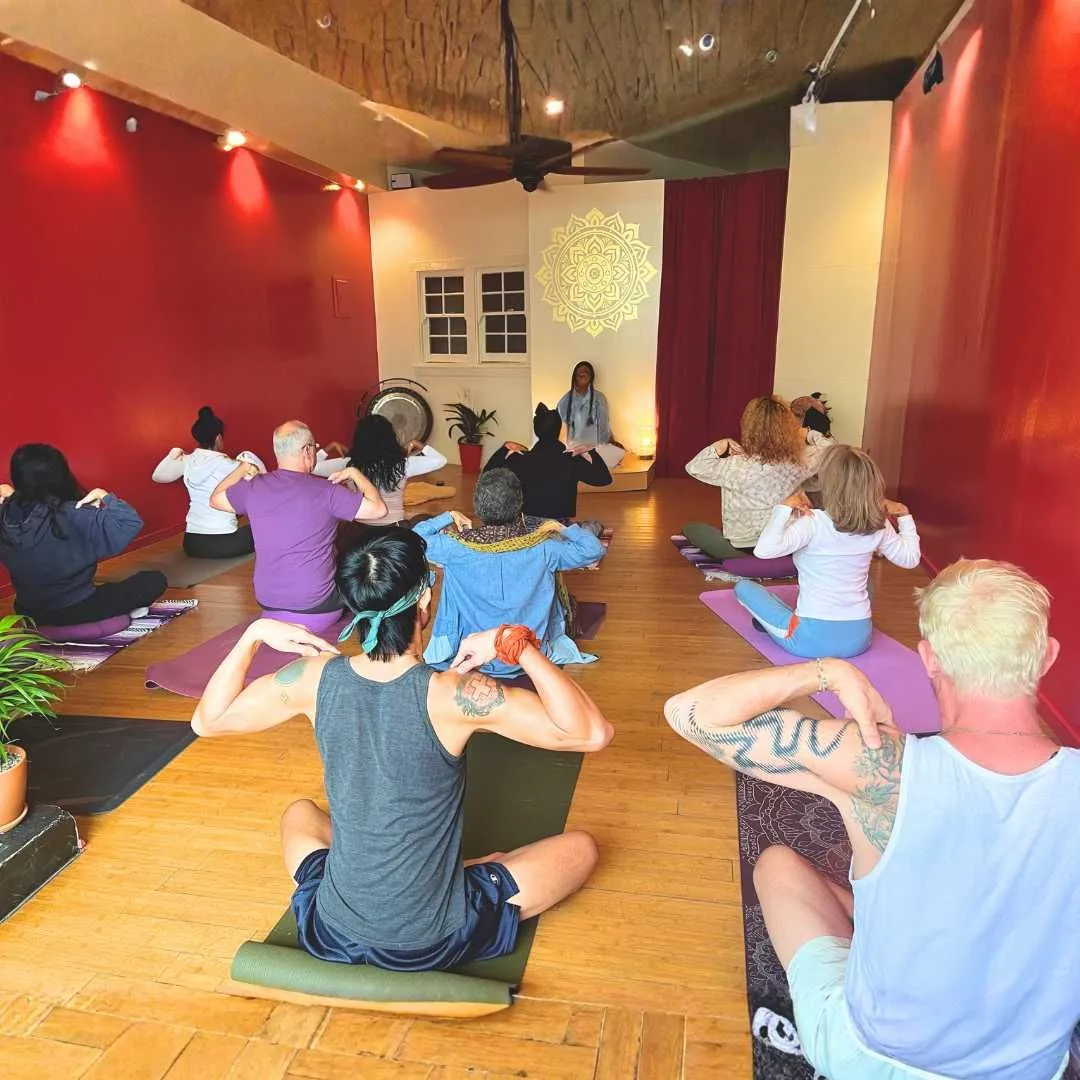 Kundalini
 Kundalini Silverlake
An intimate, affordable studio specializing in Kundalini practice, breathwork and chanting.
Open Venice
The in-person home of the Open app, blending movement, breathwork and meditation with a great sound system.
Yoga Nest Venice
An eclectic, light-filled studio known for candlelit yin, soundbaths and a magical community feel.
Frequently asked questions
Can yoga help with anxiety?
Many people find that slow, breath-led yoga helps them feel calmer and more grounded. It is a supportive wellness practice, not a medical treatment — if anxiety is affecting your daily life, talk to a doctor or qualified mental-health professional.
What kind of yoga is best for anxiety?
Gentle, slow styles tend to feel best: restorative, yin, and meditation or breath-focused classes. They keep the pace slow and the shapes grounded, which gives the nervous system room to settle rather than ramp up.
Is hot or power yoga bad for anxiety?
Not bad — just often not the calmest starting point. The heat, speed, and intensity can feel activating. If you love a vigorous class, keep it, but consider pairing it with a slower practice when you want to wind down.
How often should I practice?
Even a few minutes of slow breathing most days can help you feel steadier. A weekly slower class plus short breath breaks at home is a realistic, sustainable rhythm for most people.