Guide
Chair Yoga: What It Is, Who It's For, and How to Start
Chair yoga is the same practice with a different point of contact. Here's what it is, who it's really for, what twenty minutes of it looks like, and how the poses you already know translate to a chair.
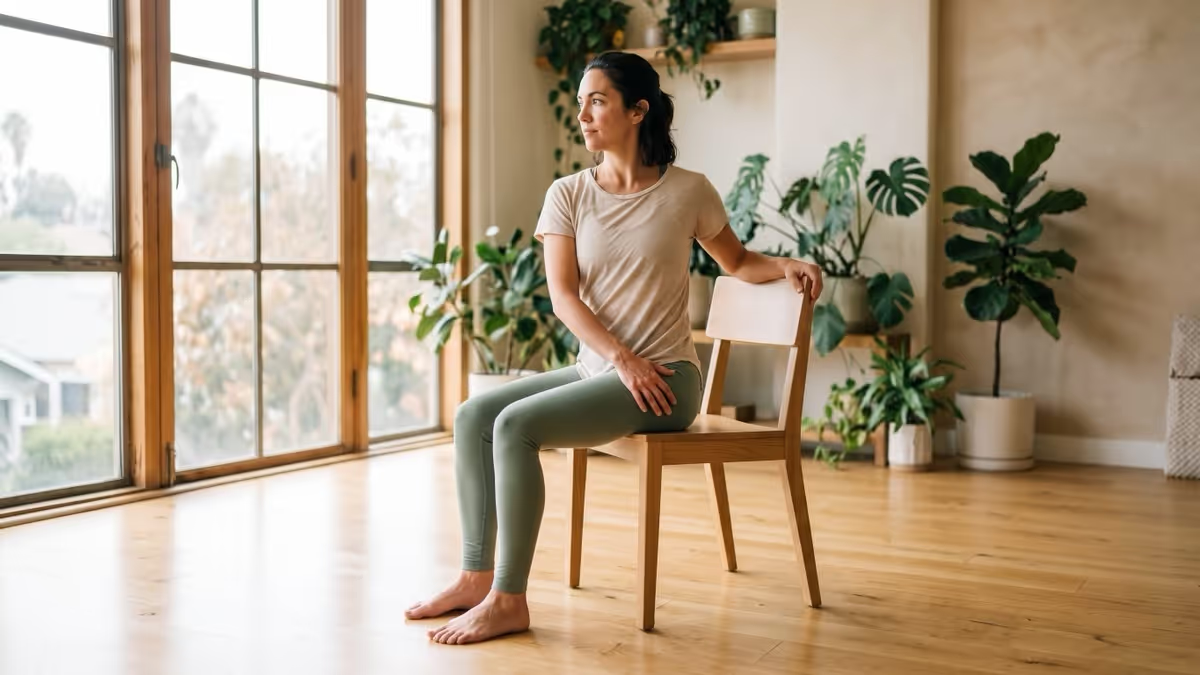
Chair yoga is a mat-free way to practice. You do the poses seated on a sturdy chair, or standing with a hand on it for support, so your body gets the same stretching, strengthening, twisting, and breathing without lowering to the floor and getting back up again. The chair is a prop, not a lesser version.
One thing to clear up before anything else: chair yoga is not Chair Pose. Chair Pose, or Utkatasana, is a standing squat where you bend your knees and sit back into thin air, no chair involved. It shares a word with chair yoga and nothing else. If you came here looking for the standing shape, that link is the one you want.
What chair yoga actually is
Props have always been ordinary in yoga rooms. Blocks bring the floor closer to your hand. Straps make your arms longer. Bolsters hold your ribs up so you can stop working. A chair sits in the same family. It is essentially a very tall block, and the thing it brings closer is the ground.
That reframing matters, because it changes what chair yoga is. It is not a separate, simplified set of exercises invented for people who cannot do real yoga. It is the same catalogue of shapes, entered from a different point of contact. Instead of your feet and hands meeting the floor, your sitting bones and feet meet the chair and the floor. Everything above that (the spine, the ribs, the shoulders, the breath), is doing what it always does.
Rooms where props are already normal, like Iyengar and restorative classes, tend to be the least surprised by this. In those rooms a chair on the mat is a Tuesday.
Who chair yoga is for
Search for chair yoga and you will find page after page framing it as content for older adults. That is a real audience, but it is a narrow read of who actually benefits.
Desk workers. After eight hours at a desk most people notice the same things: tight hips, a rounded upper back, shoulders drifting forward. Practicing in the same chair you have been sitting in all day is unreasonably efficient. You are already sitting; you just start moving on purpose.
Anyone for whom the floor is the hard part. Plenty of people can hold a pose comfortably but find the transitions brutal, down to the mat, up from the mat, twelve times an hour. Take those out and the class becomes accessible immediately.
People rebuilding after time off. After a long break, an injury that has healed, or a stretch of illness, the fastest way to quit is to start with something too hard. A chair keeps the entry low.
Larger bodies. In deep seated folds and knees-to-chest shapes on the floor, a body with more of it in the front gets compressed rather than stretched. A chair gives you room to fold from the hips without your torso running out of space.
People with nowhere to practice. Hotel rooms. Offices. A living room shared with two other people and a coffee table. If you can fit a chair, you can practice.
And yes, older adults, for the obvious reasons: no floor transitions, no one-legged balancing without support, and steady contact throughout. If that is you, or you are looking on behalf of a parent, two pages go further than this one: the free 12-minute chair yoga routine for seniors writes out a full sequence movement by movement, and our guide to yoga for seniors in LA covers what to look for in a class and how to find a welcoming studio locally. This page stays general.
Why it isn’t a lesser form of yoga
This is the objection worth answering properly, because it is the reason a lot of people who would benefit never try it.
Ask what the work in a pose actually consists of. Roughly four things: how much load your muscles carry, how much range your joints move through, what your breath is doing, and where your attention is. Hold that list up against a chair and see what falls off it.
Nothing does.
Hold your arms straight overhead for eight slow breaths. Your shoulders do not know whether your feet are in Warrior II or flat on the floor under a chair. That is the same endurance work either way. Rotate your spine to the right and look over your shoulder, and your thoracic spine rotates through the same range whether you got there lying down or sitting up. Fold forward over your thighs and your hamstrings and low back lengthen exactly as they would standing. The breath, which is the through-line of the entire practice, is completely unaffected by furniture. If anything, sitting upright and supported makes slow breathing easier to sustain. See our guide to pranayama for what that side of the practice involves.
So here is the honest accounting. What the chair removes is the floor transition and the balance risk. Those are real things, and for many people they are the entire barrier. But they are logistics. They are not the yoga.
And the honest tradeoff, because a page that only argues one side is not worth reading: a seated practice does less standing-leg strength work and less weight-bearing balance work than a standing one. Standing on one foot trains something that sitting cannot train. If building that is your goal, chair yoga is a good starting point and a poor destination. Start seated, add chair-supported standing shapes, and move toward standing practice over time. Many people never need to. Some do. Know which you are.
What a 20-minute session actually looks like
Almost nobody describes the shape of an actual session, which is strange, because it is the first thing you want to know. Here is a full twenty minutes you can do once from this page, with rough time blocks.
Settle, 2 minutes. Sit forward off the backrest. Feet flat, knees roughly over ankles. Let your weight drop into your sitting bones, stack your ribs over your hips and your head over your ribs, and let your hands rest on your thighs. Breathe normally and just notice you are sitting differently than you were.
Breath, neck, shoulders. 3 minutes. Slow the exhale until it is a little longer than the inhale. Then roll your shoulders back five times. Drop your right ear toward your right shoulder for three breaths, then the left. Turn your head slowly right and left twice. Nothing forced, no bouncing.
Seated cat-cow and side bends, 4 minutes. Hands on your knees. Inhale, lift your chest and let your back arch gently; exhale, round your spine and let your head drop. Six or eight rounds, moving at the speed of your breath. Then reach your right arm overhead and lean left for three breaths, feeling the side of your ribs open. Repeat on the other side.
Arms and chest, 3 minutes. Reach both arms straight overhead and hold for five to eight slow breaths. This gets harder than you expect. Lower, then interlace your fingers behind you (or hold the sides of the seat back), lift your chest and draw the shoulder blades toward each other for three breaths.
Twists, 3 minutes. Sit tall. Turn to the right, resting your left hand on your right knee and your right hand on the chair back. Lengthen up on the inhale, rotate slightly further on the exhale. Five breaths, then unwind slowly and repeat left. Turn from your ribs, not by cranking with your arm.
A hip shape. 3 minutes. Cross your right ankle over your left knee so your right shin runs roughly parallel to the floor. Sit tall first, then hinge forward from the hips until you feel the outer right hip. Five to eight breaths, then switch. If your knee sits high and the hip does not release, stay upright and give it time.
Ending, 2 minutes. Sit back against the backrest. Hands down, palms open or resting on your thighs, eyes soft or closed. Do nothing for two minutes and let the breath go back to its own rhythm. This part is not optional filler; it is where the session lands.
That is twenty minutes. If you want something shorter and gentler, written out movement by movement with easier and harder options, the 12-minute chair yoga routine is a good place to start instead.
The chair, the setup, and what to wear
The chair. Flat, firm seat. Four legs that stay where you put them. No wheels. Armrests are fine if they are low and out of the way, but a chair without them gives your ribs more room to twist and bend. A dining chair or a metal folding chair is close to ideal. An office chair works only if you can lock the tilt so the back does not recline under you and the casters cannot roll, better still, wedge it against a wall so it physically cannot move.
The height. You want your feet flat on the floor and your knees at roughly ninety degrees. If your feet dangle, put a couple of books under them so you have a real base to press into. If your knees ride up higher than your hips, sit on a folded blanket or a firm cushion to raise yourself.
Where to sit on it. Forward off the backrest for the active shapes (cat-cow, twists, arm work), so your spine can move freely. Back against it deliberately for the resting shapes at the beginning and end. Both are correct at different times.
The floor. On tile, wood, or laminate, put a towel or a small rug under the chair legs. Chairs slide, and worrying about it will keep you from committing your weight to anything.
What to wear. Whatever you can breathe and bend in. There is no mat, no grip issue, and no need to change into anything special. That is a genuine part of why people keep this up.
Seated versions of the poses you already know
If you have ever taken a class, you already know most of chair yoga, you just know it standing up or lying down. It is a translation, not a substitution.
A little more detail on each translation:
- Mountain pose → seated mountain. Standing, you stack ankles, hips, ribs, head. Seated, you stack sitting bones, ribs, head, with your feet pressing the floor. Same stack, one segment shorter.
- Cat-cow → seated cat-cow. Hands on your knees rather than the floor. The spine flexes and extends identically; you just are not holding your own bodyweight through your arms.
- Standing forward fold → seated fold over the thighs. Hinge from the hips and let your torso rest down toward your legs. You lose the head-below-heart position, which for a lot of people is a feature rather than a loss.
- Warrior II arms → seated warrior arms. Arms wide at shoulder height, palms down, held. Your legs are doing less; your shoulders are doing exactly the same amount.
- Reclined twist → seated twist. One hand on the opposite knee, one on the chair back. The chair back gives you something to gently rotate against, which is a genuine advantage over the floor version.
- Pigeon → figure-four on the chair. Ankle across the opposite knee, then hinge forward. Same external hip rotation, far less demand on the front knee.
If you can stand but not balance, add one more: hold the chair back with both hands and practice tree pose or a gentle lunge with the chair as your handrail. That is chair yoga too.
How often, how long, and making it stick
Short and honest: a ten-minute practice on most days does more for most people than one long session a week. Two or three sessions is a reasonable starting rhythm if daily sounds like too much.
The reason chair yoga tends to stick is not that it is easier. It is that the setup cost is close to zero. No mat to unroll, no clothes to change into, no floor space to clear, no getting down and up. When the friction between “I should practice” and “I am practicing” is one chair and twenty seconds, you do it more often. Frequency is what actually changes how your body feels, so anything that removes friction is doing real work.
Attach it to something you already do. After you make coffee. Before the first meeting. When you shut the laptop. The trigger matters more than the schedule.
This is a movement practice you are choosing, not a dose you are prescribed. If a session leaves you feeling worse rather than steadier, do less of it, not more.
Finding chair-friendly classes in LA
Straight answer: no studio in our LA listings currently advertises chair yoga as a named style on its schedule. So you are not looking for the words “chair yoga.” You are looking for rooms where props are ordinary and seated options get offered without you having to ask.
What to scan for on a schedule:
- Gentle and all-levels classes rather than power, sculpt, or heated ones.
- Restorative, where props do most of the work already and the pace leaves room for adaptation.
- Iyengar, where chairs, blocks, and belts are standard equipment and teachers are trained to adapt a shape precisely rather than vaguely.
Then call or email before you go. A short message. “I’d like to practice seated or with a chair; is there a class where that works?”. Gets you a better answer than any schedule page. Good teachers field this constantly and will point you to the right slot.
Browse the full studio directory, or start from your neighborhood. The class you will actually attend is almost always the close one.
An honest note on what this page is and isn’t
Chair yoga is a movement practice, not medical care. This guide does not diagnose, treat, or manage any condition, and nothing here is a substitute for advice from someone who knows your body.
If you are working around pain, recovering from surgery, or living with a health condition, check with your doctor before you start, and tell the teacher before class so they can adapt what you are doing. Move at a pace where you can still breathe easily, and stop anything that sharpens.
Pull up a chair, sit forward, and take ten minutes. That is the whole barrier to entry, and it was always lower than it looked.
Studios to explore
 Iyengar
 Yoga House
A genuine old-school studio with experienced teachers, Iyengar classes and a welcoming community.
Boheme Yoga
A tidy DTLA studio with hot classes, live-music sessions and restorative practice in the Historic Core.
 Beginner-friendly
 yogazan
A calm, spotless neighborhood studio with free mat rentals and teachers who welcome first-timers.
 Prenatal
 Silverlake Yoga
A warm, well-established eastside studio with classically trained teachers and strong pre/postnatal offerings.
 Pilates
 3 Wellness Home
A women-only wellness studio on Central Avenue running small-group classes (reformer Pilates, stretching and yoga), alongside EMS body-sculpt treatments and one-to-one sessions. The sculpt and Pilates side is clearly the draw; yoga is one item on a broader menu. The studio does not publish its street number on its own site, so the suite here comes from its booking listing.
 Flow
Flow Black Dog Yoga
A long-running Studio City room on Moorpark, and one of the Valley's easier studios to walk into cold. The beginner classes are genuinely for beginners rather than a slower flow. Vinyasa across levels with restorative on the schedule, plus workshops and teacher training. Street-level, with the name on the awning so you cannot miss it.
Frequently asked questions
Is chair yoga real yoga?
Yes. A pose asks for load, range, breath, and attention, and sitting on a chair changes none of those. A seated twist rotates your spine the same way a floor twist does. What the chair removes is getting down to and up off the floor, and the balance risk of standing on one leg. Those are logistics, not yoga.
Is chair yoga the same as Chair Pose?
No, and the overlap in names confuses a lot of people. Chair Pose (Utkatasana) is a standing squat shape where you sit back into imaginary air. Chair yoga is a whole style of practice done on a real chair. You can practice chair yoga for years and never do Chair Pose.
What kind of chair should I use?
A sturdy dining chair or a folding chair. You want a flat, firm seat, four legs that do not move, and no armrests blocking your ribs. Avoid a rolling office chair unless you can lock the tilt and the casters, and even then it is better wedged against a wall.
Do I need a mat for chair yoga?
No. That is much of the point. On a hard floor a towel or a rug under the chair legs stops it sliding, and that is the only equipment worth bothering with.
Is chair yoga only for seniors?
No. It is popular with older adults, but the practice suits desk workers with locked-up hips, anyone who finds getting to the floor the hardest part of a class, people easing back after time off, larger bodies that get compressed rather than stretched by deep floor folds, and anyone practicing in a hotel room or office with no floor space.
What will I actually notice from chair yoga?
The ordinary things you would expect from moving and breathing on purpose. Your shoulders and ribs get through a fuller range than they do in a normal day at a desk. Your spine gets flexed, extended, twisted and side-bent instead of held in one shape for hours. And ten quiet minutes tends to leave you steadier than you started. It is a movement practice rather than treatment for anything, and what people notice comes from repeating it, not from any single session.
How often should I do chair yoga?
Two or three sessions a week is a realistic start, and ten minutes most days works better than one long weekly session for most people. Do what you will actually repeat rather than what looks best on paper.