Guide
Standing Yoga Poses, Explained
Standing poses are the alphabet of yoga — get them right and everything else gets easier. Here's a plain-English tour of the foundational shapes, the alignment basics that make them work, and where to learn them properly.

If yoga had an alphabet, the standing poses would be it. Before you ever fold into a deep backbend or balance on your hands, you learn to stand — really stand, with your feet rooted, your legs working, and your spine long. Every fancier shape you see later borrows its grounding and its logic from these foundational poses. Learn them well and the rest of yoga stops feeling like a mystery.
This guide is the plain-English tour: what the core standing poses actually are, the alignment basics that make them safe and effective, and where in LA you can learn them properly rather than just copying the person on the next mat.
Why standing poses are the foundation
Standing poses do a lot of quiet work. They build the strength to hold yourself up, the balance to stay steady, and the body awareness to know where your limbs are without looking. They also teach the single most transferable skill in yoga: grounding down through your feet to create stability everywhere above.
That’s why almost every class — gentle or intense, slow or sweaty — spends real time on its feet. The shapes are simple enough to learn early and deep enough to keep refining for years. A beginner and a teacher of twenty years are both still working on the same triangle pose; they’re just feeling different layers of it.
The other reason they matter: standing poses are forgiving. You can practice every one of them with a wider stance, a shorter reach, a hand on the wall, or a block under your palm. There’s always a version that fits today’s body, which makes them the safest place to build a real practice from scratch.
The foundational poses
You don’t need a hundred poses. A handful carries most of the weight, and the rest are variations on these.
Mountain pose (Tadasana)
It looks like just standing, and that’s the point. Feet about hip-width, weight even across both soles, legs active, spine tall, shoulders relaxed down the back. Mountain teaches you how to stack your body — ankles under hips, hips under shoulders — and that stack is the template for every standing pose that follows. If you only learn one thing, learn how to stand here.
Warrior I and II (Virabhadrasana I & II)
The warriors are where strength shows up. In Warrior II you step wide, bend the front knee over the ankle, and reach your arms long in opposite directions while your gaze travels over the front hand. In Warrior I the hips face forward and the arms lift overhead. Both build leg strength and open the hips, and both teach you to be strong and steady at the same time — grounded legs, lifted chest.
Triangle (Trikonasana)
Triangle teaches length and rotation. From a wide stance you extend over your front leg and reach toward the floor, the opposite arm lifting toward the ceiling so your torso opens like a book. The temptation is to reach low and collapse; the lesson is to stay long. A block under the lower hand is not cheating — it’s how you keep the pose honest while your body opens over time.
Chair (Utkatasana)
Chair asks you to sit into an invisible seat: knees bent, hips back, arms reaching up, spine long. It’s deceptively hard and wonderfully direct — you feel your legs and core working within seconds. Chair teaches you to load your legs with control, which is exactly the engine behind stronger, more athletic flows.
Learn these four well and you’ll recognize their shapes inside nearly every standing sequence a teacher throws at you.
Alignment basics that keep you safe
Alignment sounds technical, but it comes down to one idea: stack your joints so your bones carry the load and your muscles do the controlled work. Get that right and standing poses feel solid instead of strained. Here are the basics that apply almost everywhere.
Ground through your feet first
Every standing pose starts at the floor. Spread your toes and press evenly through the ball of the foot, the little-toe edge, and the heel — a stable, three-point base. Strong, awake feet are the quiet engine of balance; build the shape on top of them, not the other way around.
Stack your joints
Keep your knee tracking over your ankle, not collapsing inward or sliding past your toes. Stack your hips over your knees and your shoulders over your hips where the pose allows. When joints line up, the load travels safely through your bones instead of grinding into the joint itself.
Engage, don’t lock
Keep your standing leg strong but let the knee stay soft — never snapped fully straight and locked. Engaged-but-unlocked muscles protect the joint and keep you ready to adjust your balance.
Let breath set the pace
If you’re holding your breath, you’re probably forcing the shape. Steady, even breathing keeps you calm and tells you when you’ve gone too far — a pose you can breathe smoothly in is a pose you’re actually ready for. Breath is the built-in gauge for everything else.
None of this is about looking perfect. It’s about building habits that hold up over years, so the practice keeps giving rather than slowly wearing you down.
Where to learn them properly in LA
You can absorb the basics in almost any all-levels class, but two styles teach standing poses especially well — from opposite ends.
Iyengar — precision and props
Iyengar yoga is the most alignment-obsessed style there is. It holds poses longer, uses props generously, and breaks each shape down piece by piece so you understand why every alignment cue exists. If you want to learn standing poses from the inside out, this is the gold standard. In LA, Yoga House in Pasadena is a long-running studio with Iyengar at its core — a place built for exactly this kind of careful, foundational learning.
Power — repetition and intensity
Power yoga teaches the same shapes the other way: through repetition, heat, and stamina. You’ll flow through warriors, triangles, and chairs again and again until they become second nature and genuinely strong. Sweat Yoga in Santa Monica is a solid power option for building that capable, athletic version of the foundations.
Many people learn the precision in an Iyengar room and the endurance in a power class, and the two reinforce each other beautifully. To find what’s near you, browse the directory by style — the foundations are best learned at a studio close enough that you’ll actually keep showing up.
How to practice the foundations
Building a foundation doesn’t take a complicated plan. It takes patience and a few honest habits.
- Start in mountain. Take a few real breaths standing before you flow. It resets your alignment for everything after.
- Use props without apology. A block under your hand or a wall at your back is how you learn a pose correctly, not a sign you’re behind.
- Hold a beat longer. Standing poses reveal their lessons when you stay. Give each one a few steady breaths instead of rushing through.
- Watch your front knee. In every lunge and warrior, keep it tracking over the ankle. It’s the single most protective habit you can build.
- Come back to the same poses. Depth comes from repetition, not novelty. The same five shapes, practiced often, will teach you more than fifty you do once.
Standing poses reward the patient. Root down, stack with care, breathe steadily, and let the same simple shapes get quietly deeper every time you return to them. Get the foundation right and the whole practice opens up on top of it.
Studios to explore
 Iyengar
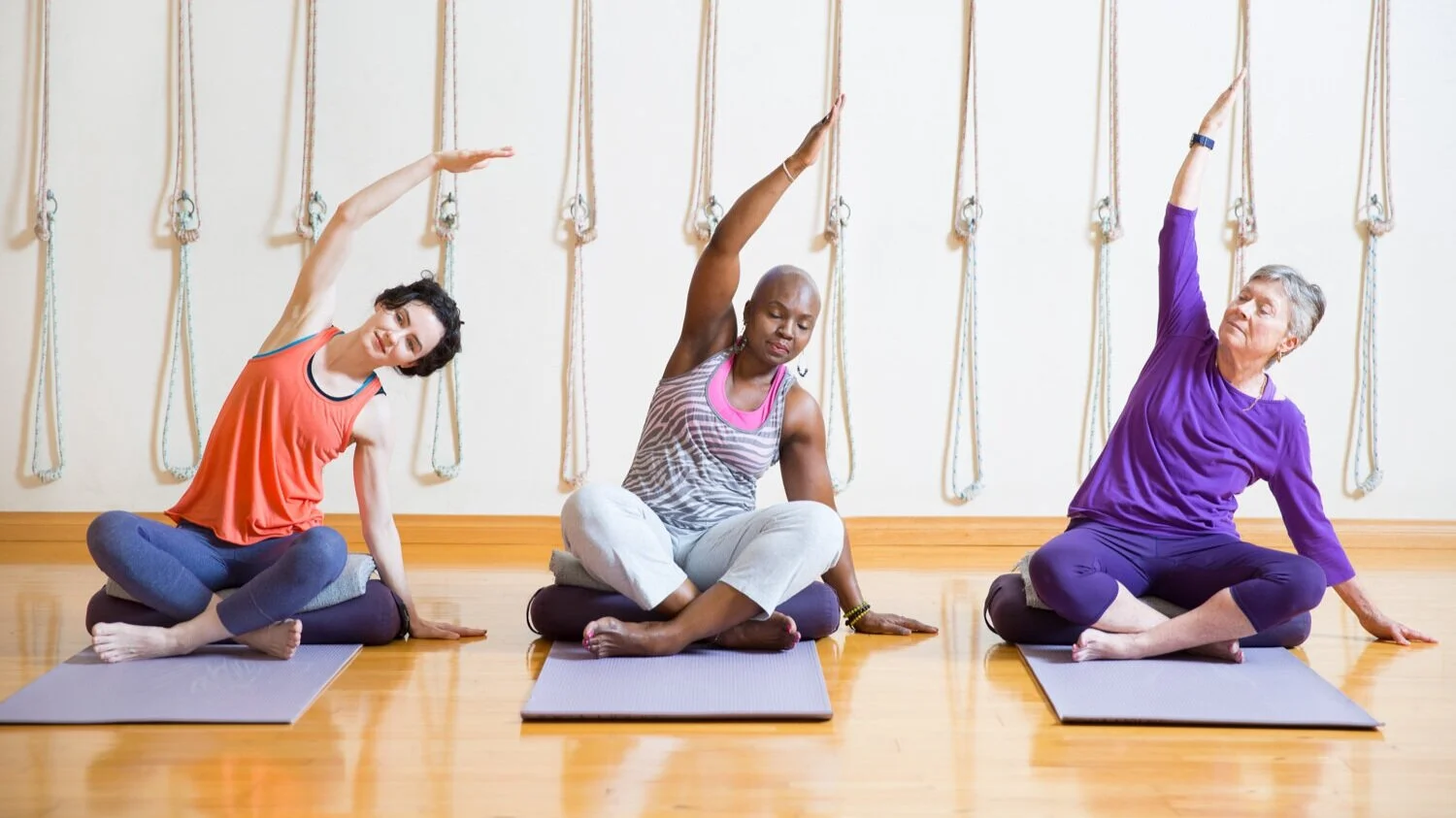
 Yoga House
A genuine old-school studio with experienced teachers, Iyengar classes and a welcoming community.
 Iyengar
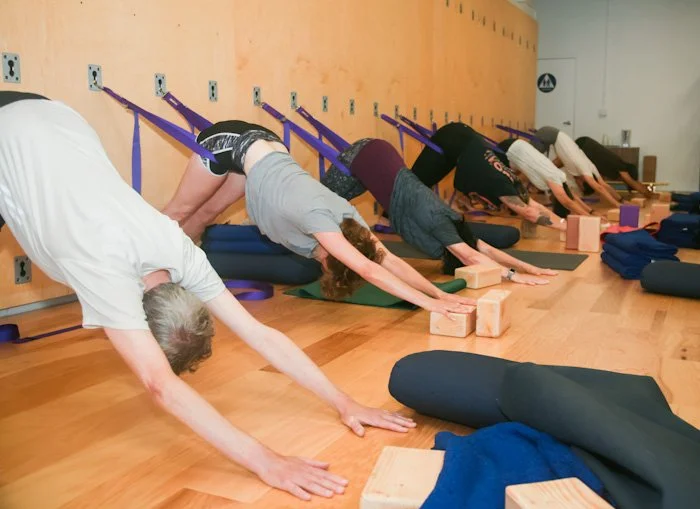
 BKS Iyengar Yoga Center of Santa Monica
A single-method Iyengar room on Broadway, taught with the full kit of props — belts, blocks, bolsters and wall ropes — and the alignment-first approach the method is known for. The timetable runs levelled classes, a continuing beginner course, a weekly therapeutics class and a midweek lunchtime session, with some classes also streamed online. The studio takes no incoming calls: book online, or text 310-601-8585.
BKS Iyengar Yoga Institute of Los Angeles
The non-profit Iyengar institute for Los Angeles, on Washington Boulevard, with a daily schedule split between studio, online and hybrid classes. Every class is taught by a Certified Iyengar Yoga Teacher, so the instruction is hands-on and the props do a lot of the work. Alongside the timetable it runs workshops, teacher training and the local Iyengar association. Enter through the parking lot at the back.
 Flow
Flow Center For Yoga
The studio calls itself the longest continuously operating yoga room in Los Angeles — founded in 1967 and on Larchmont since 1969, in a 1925 building that was a Masonic temple and then a dance school. Nine formats run off one schedule, from a foundational level-one class and Iyengar through vinyasa, infrared hot flow, power sculpt, pilates and restorative.
 Flow
Flow Red Diamond Yoga Palms
A Palms studio at the corner of Palms Blvd and Overland Ave, running vinyasa, yin, Iyengar, sculpt and Ashtanga classes alongside meditation sessions and its own teacher training program.
Sweat Yoga Santa Monica
Candlelit, no-mirror hot yoga in downtown Santa Monica with a loyal, packed-room following.
Frequently asked questions
What are the most important standing yoga poses to learn first?
Start with mountain pose, the two warriors, triangle, and chair. Mountain teaches you how to stand and stack your body; the warriors build strength and open the hips; triangle teaches length and rotation; chair teaches you to sit into your legs. Almost every other standing pose is a variation or combination of these few, so learning them well makes everything afterward easier.
Why does alignment matter so much in standing poses?
Alignment is simply stacking your joints so your bones carry the load and your muscles do the controlled work, rather than your joints absorbing strain. Good alignment makes a pose both safer and more effective — you feel the right muscles working and protect your knees, hips, and lower back over the long run. It's not about looking perfect; it's about building habits that hold up over years of practice.
Which yoga style is best for learning standing poses properly?
Iyengar yoga is the most detail-focused — it holds poses longer, uses props generously, and breaks down alignment step by step, which makes it excellent for learning the foundations. Power yoga teaches the same shapes through repetition and intensity, building strength and stamina. Many people learn the precision in one and the endurance in the other; LA has well-regarded studios for both.
Do I need to be flexible or strong to start standing poses?
No. Standing poses are where you build both flexibility and strength, so you don't need either in advance. Beginners can practice every foundational pose with the help of props, a wall, or a shorter stance, and the shapes deepen naturally as your body adapts. Starting where you are is the whole point.