Guide · For players at every level
Yoga for Soccer Players: The Complete Guide
Hamstrings, hip flexors, groin, ankles, soccer loads the exact tissues yoga is best at restoring. An eleven-pose lineup mapped to the pitch, a match-week schedule, and what to actually do the day after a match.
Soccer is thousands of short sprints, decelerations, and one-legged landings. Every one of them tightens hip flexors, loads hamstrings near their limit, and stiffens ankles that are already asked to absorb tackles and turf. Yoga is not a replacement for the strength work in your programme. It is the counter-movement to what the game keeps doing to your body.
This guide treats the practice the way a coach treats a team sheet. Eleven poses are picked and arranged in a 4–3–3, each one earning its place because of the tissue it protects. Around that lineup sits a match-week schedule built for one fixture a week, a season plan that separates building from maintaining, and the four mistakes that send athletes home from their first class sore in the wrong places.
Nothing here needs a studio, a heated room, or more than about ninety minutes across a whole week. If you can find a wall and a patch of floor, you can run the entire plan, and if you do want a teacher, the LA studio directory is one page away.
Why yoga belongs in a soccer week
The game shortens you; the practice lengthens you back. Yoga is not a replacement for strength work, it is the counter-movement to what thousands of sprints, decelerations and one-legged landings do to your body.
Range you can sprint on
Hip extension for a longer stride, open adductors for lunging tackles and in-swinging crosses, ankles that flex deep enough to stay over the ball. Long, loaded holds build range the tissue keeps.
Faster between matches
Slow, long-exhale breathing shifts the nervous system toward its rest state, the mode where tissue actually repairs. A 30-minute restorative session the day after a match beats another day on the couch.
Balance and focus
Single-leg balance under fatigue is where ankle sprains and bad touches live. Standing balance poses train exactly that, and the breath control transfers to penalty-spot composure.
Where soccer breaks players
Elite-club injury surveillance keeps finding the same thing: hamstring strains are the single most common injury in professional soccer, with groin and adductor problems close behind. Each risk zone below is paired with the pose in this guide that targets it.
The poses that matter most
Defense is stability, midfield is mobility, attack is spring. Tap any position on the board to read its pose, what it targets, how long to hold it, and when in the week it earns its start.
Tap a position on the board, or press ← / → to walk the lineup.
The match-week plan
Five short sessions, placed where they help. Built around one match a week, shift everything if you play weekend league. Total cost is about 90 minutes, and none of it competes with training.
Recovery session, 30 min, the day after
All floor, all slow: Legs-Up-the-Wall, Figure-Four, reclined twist, long Savasana with extended exhales. The goal is parasympathetic, heart rate down, tissue repair on.
Hips & adductors, 20 min, after strength work
Low Lunge, Lizard, Wide-Leg Fold, Garland. Longest holds of the week (60–90 seconds), far from match day, deep range is safe to chase.
Posterior chain, 15 min, evening
Half Splits, Down Dog with calf pedal, Bridge. Hamstrings and calves get their focused day while the heaviest sprint session is still 48+ hours out.
Light flow & breath, 12 min
Easy sun salutations at half effort, Warrior III for a few breaths a side, then five minutes of box breathing. Nothing deep, nothing new, just grease the hinges and calm the head.
Dynamic only, inside the warm-up
Leg swings, walking lunges with reach, open-the-gate hips, a few slow deep squats. Save the long static holds for after the whistle, not before it.
In-season vs. off-season
| Phase | What yoga is for | Dose | Style that fits |
|---|---|---|---|
| In-season | Recovery and maintenance. Protect the range you have; don't chase new range in congested weeks. | 4–5 short sessions / week (the match-week plan above) | Restorative, yin, gentle flow |
| Off-season | Build. This is when longer holds actually add range, and when a real class habit is easiest to start. | 2–3 full classes / week, 60 min | Vinyasa or power for load, one yin class for depth |
| Pre-season | Bridge the two: keep building early, taper toward maintenance as friendlies start. | 3 sessions / week, shortening | Flow early, restorative as matches return |
Mistakes to avoid
Four mistakes soccer players make on the mat.
Treating it like a competition
You will lose a flexibility contest with the lifelong yogi on the next mat, and forcing depth is how athletes get hurt in class. Your range will come, measured in months, and it sticks.
Deep static work before explosive work
The order matters: dynamic before you play, static after. A yin class the morning of a match is well-meant self-sabotage.
Skipping it the week you're sore
The sore weeks are the point. Gentle range and long exhales move recovery along faster than full rest, MD +1 is the most valuable session in the plan.
Only stretching what already feels tight
Hamstrings feel tight partly because weak glutes make them overwork. Keep the strength poses, Bridge, Warrior III, Chair, or the stretching chases a symptom.
Frequently asked questions
Will yoga make me slower or too loose to play well?
No. Sprint speed depends on tendon stiffness, which long holds don't change. What softens is the range-limit behind strains and shortened stride, paired with your normal strength work, power stays.
How long until I notice a difference on the pitch?
Recovery effects, less next-day heaviness, show up within two weeks. Real range-of-motion change in hips and hamstrings is visible at six to eight weeks of consistent short sessions.
Can I just do this at home instead of taking a class?
Yes, the match-week plan is built for 12-to-30-minute home sessions. A weekly studio class is still worth it in the off-season, mainly so a teacher can catch compensations you can't feel yourself.
Is this suitable for youth players?
Yes, with lighter holds and no forced depth, growing bodies need less range work, not more. Keep sessions short and skip the deepest hip openers until growth plates close.
I'm coming back from a hamstring strain, where do I start?
With your physio's clearance, not this guide. Once cleared for stretching, start well short of the pain-free limit with Bridge and gentle Half Splits, and hold off on deep forward folds for the first month.
Which yoga style should I look for at a studio?
In-season, restorative or yin, mention you're an athlete in a match week. Off-season, vinyasa or power for strength-through-range, plus one yin class for depth. Skip heated classes within 48 hours of a match.
Studios to explore
Power Yoga East
A light-filled second-floor loft focused on breath-led, steady practice rather than high-intensity flow.
Boheme Yoga
A tidy DTLA studio with hot classes, live-music sessions and restorative practice in the Historic Core.
Hot 8 Yoga Pasadena
A large, much-loved Old Town studio with a serene outdoor courtyard and classes from dawn to night.
Yoga Circle Downtown
An old-school, down-to-earth studio with strong yin classes and a robust livestreaming option.
Sweat Yoga Santa Monica
Candlelit, no-mirror hot yoga in downtown Santa Monica with a loyal, packed-room following.
 Sculpt
 CorePower Yoga Beverly Grove
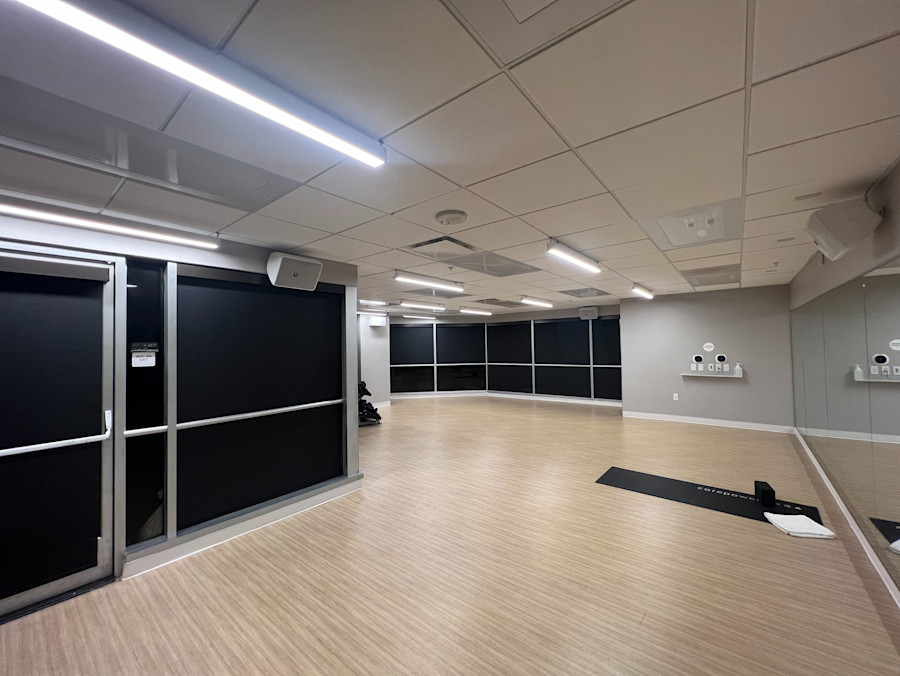
The Wilshire Boulevard room, on the lower level of an office tower near Fairfax. Heated power classes and weighted sculpt on the chain's usual daily schedule, in a large, plain, well-lit room.
Ready for a teacher? Browse LA yoga studios by style and neighborhood, filter for yin, restorative or power and tell them you play.