Guide
Yoga for Athletes in LA
Yoga isn't soft cross-training — it's mobility, recovery, and breath work that makes you a more durable athlete. Here's how it fits a training week in LA, and where to find the right room.

If you run, lift, or play a sport, you’ve probably been told to “do some yoga” by a coach, a physical therapist, or that one teammate who swears by it. And you’ve probably pictured a slow, quiet room and wondered how it connects to faster splits or a bigger squat. Fair question. The honest answer: yoga is one of the best cross-training tools an athlete has — but only if you treat it like training, not like a nap with extra steps.
This guide is the practical version. What yoga actually does for athletic bodies, how to pick the right class for the day, and where to practice it in LA.
Why athletes practice yoga
Most sports ask you to do one thing, over and over, very well. Running is thousands of identical strides. Lifting grooves the same patterns under load. Team sports add sprints, cuts, and collisions, but still inside a fairly narrow set of movements. That repetition builds skill — and it also builds tightness, imbalance, and blind spots in the ranges you never use.
Yoga works the gaps. It moves you through full ranges of motion under your own control, asks you to balance on one leg and stay there, and trains the small stabilizing muscles that heavy lifts and fast miles tend to skip. The payoff isn’t a party trick. It’s a body that’s harder to injure and easier to move.
Mobility: range you can actually use
There’s a difference between flexibility — how far a joint can be pushed — and mobility — how much of that range you can move through with strength and control. Athletes need the second kind. A hamstring that’s long but weak at the end of its range doesn’t help you; a hip that can both open wide and drive hard does.
Strong, dynamic yoga is excellent for this. Holding a deep lunge, flowing through standing poses, and stabilizing in balance shapes all build mobility that’s load-bearing — range with strength baked in. Power classes and hot yoga lean into this: they’re demanding, full-range, and they leave you with hips, shoulders, and ankles that work better the next time you train.
Where you’ll feel it first
Lifters tend to notice it in overhead positions and in the bottom of a squat, where tight ankles and shoulders quietly cap how much you can do. Runners usually notice it in the hips and ankles — more stride, less grind — and there’s a whole chain behind that, which the runners’ guide walks from the foot up. Either way, it isn’t a flexibility problem you can stretch away passively. It’s mobility, and you build it by moving through the range with intent — which is exactly what a good class makes you do.
Recovery: training the off-switch
Here’s the part most athletes underuse, and it’s where the biggest return often hides. Hard training keeps your nervous system revved — alert, tense, ready to go. The problem is that recovery, the actual adaptation, happens when you can downshift out of that state. If you live keyed-up, you recover slower.
Slow, quiet yoga is training for the off-switch. Long held poses, gentle floor work, and a few minutes of stillness teach your nervous system to let go on purpose. Done on an easy or rest day, a restorative-style session can leave you looser, calmer, and genuinely more recovered for the next hard effort. It’s not that you didn’t “work hard enough.” It’s that recovery is a skill, and this is how you practice it.
This is general wellbeing, not medicine — if you’re working through an injury, loop in a physical therapist or doctor, and treat yoga as a complement to their plan, not a substitute for it.
Breath and focus under pressure
Watch a lifter set up for a max attempt, or a runner hold form through the last hard interval. The thing keeping them together is breath. Yoga is, at its core, the practice of staying steady while your breath stays steady — and that’s a directly transferable skill.
When you learn to keep a long, even breath while you’re holding a hard shape on the mat, you’re rehearsing the same self-control you want on the start line, at the bottom of a heavy squat, or in the final minutes of a match. Meditation and breath-led classes make this explicit, but you’ll get plenty of it in any strong flow, because staying calm in difficulty is half of what the practice is. Focus works the same way: an hour of bringing your attention back to one breath, one pose, one balance is reps for the kind of attention competition demands.
How to fit it into a training week
You don’t need to overhaul your schedule. Start with one session a week and let it earn its place. A simple way to think about it:
- One strong session — a power or hot class — on an easy training day, to build mobility and capacity without competing with your hard work.
- One recovery session — slower, quieter, floor-based — on a rest day or the day after your hardest effort, to help you downshift and adapt.
That’s a complete athletic yoga week, and plenty of people get real results from just the first one. Put the strong class where it won’t steal energy from key workouts, and put the recovery class where you actually want to recover. Skip heavy yoga the day before a race or a max-out — treat it like any other quality session and respect the taper.
By sport: where the plan gets specific
Everything above is true for any athlete. What changes from sport to sport is which tissue takes the beating — and once you know that, the same two sessions a week get a lot more targeted. Two sports have enough of a pattern to be worth their own guide.
Running
Running is the same stride, thousands of times, and it loads one long connected chain: plantar fascia, achilles, calf, hamstring, glute, hip flexor, lateral hip, lower back. That’s why treating a sore calf as a calf problem tends not to stick — the link that’s complaining is rarely the link that’s causing it. Two things surprise most runners: you can’t stretch the IT band itself (it’s dense fascia, not muscle — the fix is hip strength and lateral-hip range), and deep static holds temporarily blunt force output, so they belong after a run, never in the hour before a hard one.
Yoga for runners → — the chain walked link by link with a pose for each, a training-week plan, and what to do in race week.
Soccer
Soccer is sprints, cuts, decelerations and one-legged landings, which is a precise recipe for hamstring, groin, hip flexor and ankle trouble — hamstring strains are the most common injury in the professional game. The scheduling matters as much as the poses: deep holds sit at MD −4, not in the warm-up, and the day after a match is the single highest-value session of the week. Weak glutes are also a hidden cause of hamstrings that feel permanently tight, so strength shapes earn their place alongside the stretches.
Yoga for soccer players → — an eleven-pose lineup mapped by position, a match-week schedule, and in-season versus off-season programming.
Everything else
Lifting, cycling, tennis, climbing, team sports without a guide yet — the plan on this page is the right starting point. One strong session for mobility and capacity, one recovery session for the off-switch, both placed around your hard days. Add sport-specific work once the habit is stable, not before.
Where to practice in LA
The right room depends on the day. For the strong, mobility-building work, Los Angeles is full of power and hot studios that’ll challenge a fit athlete: the city’s power and hot yoga studios range from sweaty, athletic flows to high-intensity heated rooms, so you can find a class that matches the intensity you’re used to. For recovery work, look for restorative, yin, or slow-flow classes — often the same studios run both.
Browse the directory by style when you know what kind of session the day calls for, or by neighborhood to find something close enough that you’ll actually keep going. Many studios offer a discounted intro week, which is a low-pressure way to test how a class fits alongside your training before you commit.
Treat it like training, schedule it like training, and yoga stops being the thing your coach nags you about and becomes the thing that keeps you in the game.
Studios to explore
Hot 8 Yoga Santa Monica
A polished hot-yoga studio with a deep class menu spanning yin, power, sculpt and barre fusion.
 Hot yoga
 Veda Yoga
A welcoming two-room studio with infrared heat, sculpt classes and immersion/teacher-training programs.
CorePower Yoga Downtown LA
A central branch of the national chain with reliably heated classes and easy drop-in scheduling.
TruFusion West Hollywood
A large multi-modality studio mixing heated yoga with HIIT, boxing, cycling and barre under one roof.
Sweat Yoga Santa Monica
Candlelit, no-mirror hot yoga in downtown Santa Monica with a loyal, packed-room following.
 Sculpt
 CorePower Yoga Beverly Grove
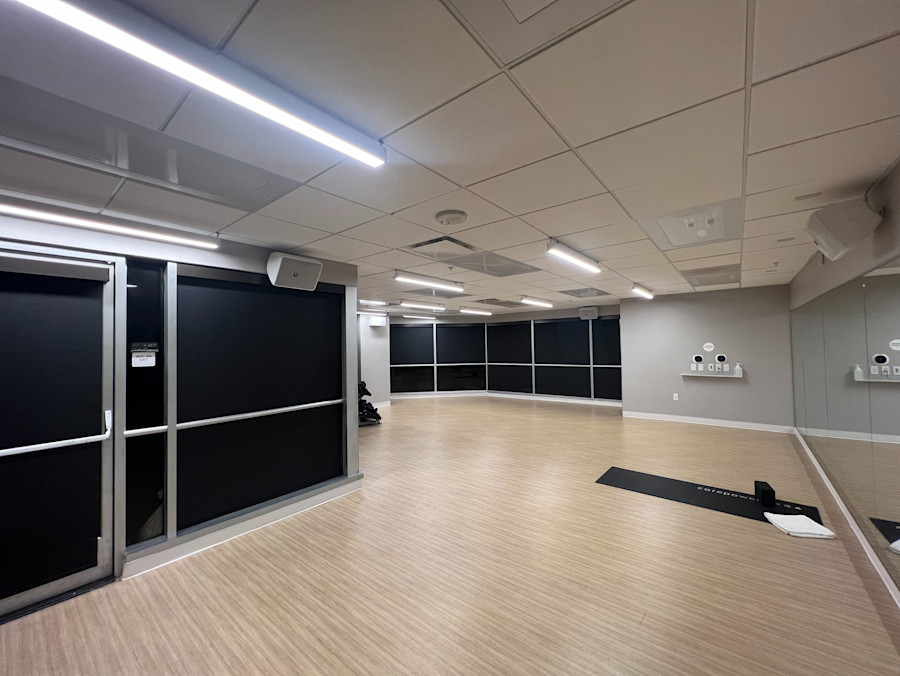
The Wilshire Boulevard room, on the lower level of an office tower near Fairfax. Heated power classes and weighted sculpt on the chain's usual daily schedule, in a large, plain, well-lit room.
Frequently asked questions
Will yoga make me less explosive or 'too flexible'?
No. Most athletes are under-mobile, not over-flexible. Yoga improves the range you can actually control, which tends to make movement more powerful and efficient, not less. You'd have to train flexibility very aggressively and ignore strength work entirely to lose power — that's not what a weekly class does.
How often should an athlete practice?
Once a week is plenty to start and still makes a difference. Many athletes settle into one stronger, mobility-focused session and one easier recovery session per week. Slot them on easy or rest days so they don't compete with your hard training.
Should I take a hot or power class, or something gentle?
It depends on the day. Strong, dynamic styles like power or hot yoga build capacity and full-range mobility and pair well with your training. Slower, restorative-style classes are for recovery between hard sessions. A good week often has some of both.
Is there a version of this for my specific sport?
For running and soccer, yes — we have full guides for each, because those two sports load very particular tissue. Running works one long chain from the plantar fascia up to the lower back; soccer punishes hamstrings, groin, and ankles through cutting and deceleration. For lifting and most other sports, the plan on this page is the right starting point: one strong session, one recovery session, placed around your hard days.
I can barely touch my toes — am I too stiff to start?
Stiff is exactly who this is for. You don't need any baseline flexibility to begin, and tight hamstrings or hips are a reason to start, not a reason to wait. Tell the teacher it's your first class and they'll give you the modifications you need.