Los Angeles · Yoga News
Pelvic Floor Yoga Eased Bladder Distress a Little More Than Exercise in a California Trial
Urge leaks fell by about the same amount with yoga as with general exercise. Yoga did better on how bothersome the symptoms felt, and on daytime bathroom trips. A modest result, from a subgroup of a trial whose main result was neutral.
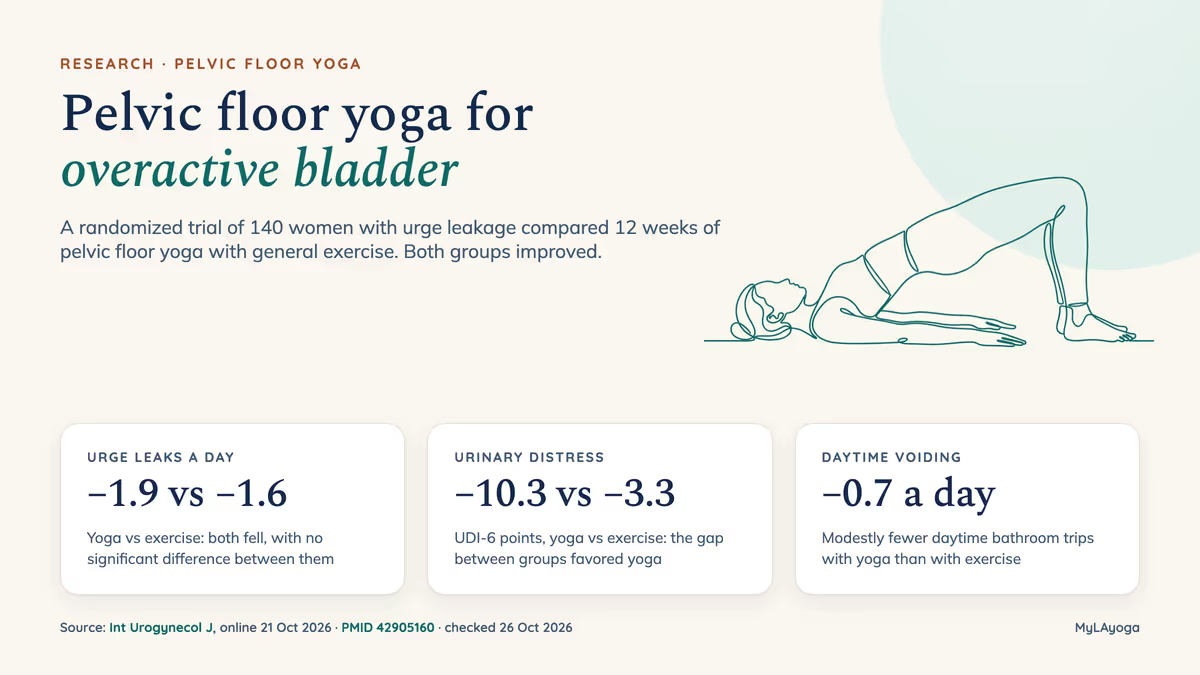
A new analysis from a California yoga trial, published online in the International Urogynecology Journal on 21 October 2026, looked at women whose overactive bladder makes them leak. After 12 weeks, pelvic floor yoga and a general exercise program cut leaks by about the same amount, and yoga came out modestly ahead on how much the symptoms bothered people. The researchers are at Stanford University and the University of California, San Francisco.
What the study did
The paper is a prespecified subgroup analysis of a larger randomized trial. It covers the 140 women in that trial who had “OAB-wet”: overactive bladder with urgency urinary incontinence, the sudden urge to go that ends in a leak. They averaged 2.8 such leaks a day at the start. They were randomized to one of two 12-week programs:
- Pelvic floor yoga (71 women): group instruction plus practice on their own.
- Physical conditioning (69 women): the same amount of instruction and practice time, spent on general muscle stretching and strengthening.
Symptoms were tracked with bladder diaries and with the UDI-6, a short questionnaire on how much urinary symptoms bother you, at 6 and 12 weeks.
What it found
- Urge leaks fell in both groups: by 1.9 a day with yoga and 1.6 with exercise. The difference between the groups was not statistically significant.
- Urinary distress: UDI-6 scores fell by 10.3 points with yoga and 3.3 with exercise. The authors note that neither group’s own change was significant, but the gap between the groups was, and it favored yoga.
- Daytime trips to the bathroom fell modestly more with yoga, by about 0.7 a day compared with exercise.
The authors’ conclusion is measured: women reported improvement from both programs, “with yoga showing modestly greater reductions in urinary distress and daytime voiding frequency.”
Why you should hold it loosely
- The parent trial’s main result was neutral. That trial, published in Annals of Internal Medicine in 2024, randomized 240 women aged 45 to 90 at three California sites, with twice-weekly classes and once-weekly practice at home in pelvic floor-specific Hatha yoga. Total leaks fell by 2.3 a day with yoga and 1.9 with exercise, and the authors concluded that pelvic yoga “was not superior” to the general program.
- A subgroup is a slice of a trial. This one was planned in advance, which helps, but it is still a smaller group than the trial was designed around.
- The comparison was another exercise program, not no treatment and not the usual clinical treatments, a limitation the 2024 paper names itself. Instruction moved to videoconference during the COVID-19 pandemic.
- Disclosures: two of the authors report advisory or research ties to drug companies (Sumitomo Pharma and AbbVie for one, Lilly for another); the others report none. The 2024 trial was funded by the National Institutes of Health.
The practical version
Both programs helped, and yoga was at least as good as general exercise, a little better on how the symptoms felt. If leaks or urgency are bothering you, start with a doctor or a pelvic floor physical therapist, who can tell you what kind of incontinence you have. If gentle, regular practice appeals, our studio directory lists classes across Los Angeles, and the restorative listings are a calm place to begin.
Sources
- Pelvic Floor Yoga for Women with Overactive Bladder-Wet: A Subgroup Analysis of a Multisite Randomized Trial, International Urogynecology Journal, online 21 October 2026 (PubMed abstract)
- Efficacy of a Therapeutic Pelvic Yoga Program Versus a Physical Conditioning Program on Urinary Incontinence in Women: A Randomized Trial, Annals of Internal Medicine, 2024 (PubMed abstract)
Want your studio in the directory? Add your studio.