Los Angeles · Yoga News
Yoga Added to Usual Care Cut Extra Heartbeats in a 12-Week Trial, With Caveats
At 12 weeks the yoga group's median extra-beat burden was 6.55% against 16.89% with usual care alone, a significant difference after adjustment. Encouraging, and far from settled.
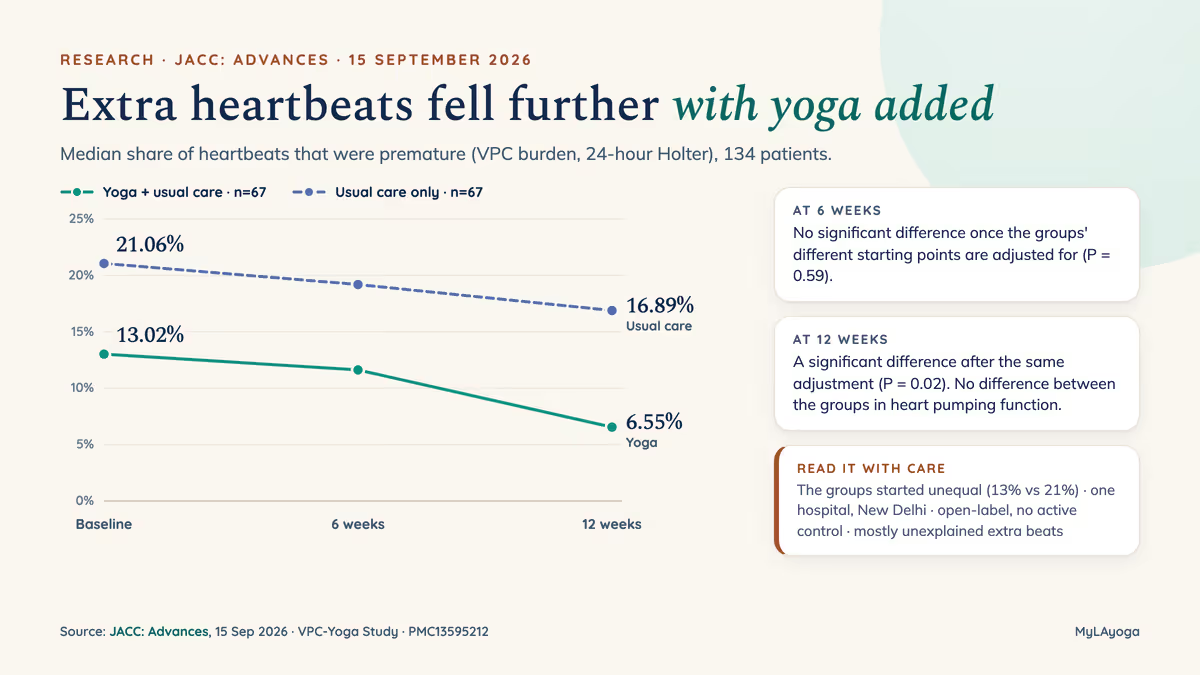
A randomized controlled trial published in JACC: Advances, a journal of the American College of Cardiology, on 15 September 2026 found that adding a structured yoga program to usual care lowered the burden of extra heartbeats in patients who have a lot of them. The result is real but modest in what it can prove, and the authors say so.
What the study did
The extra beats in question are premature ventricular complexes (VPCs), early beats from the heart’s lower chambers that some people feel as a skipped or extra beat. Researchers at the All India Institute of Medical Sciences in New Delhi enrolled 134 adults whose 24-hour heart monitor showed VPCs making up at least 5% of their beats, and randomized them evenly:
- Yoga plus usual care (n=67): six supervised sessions in the first two weeks, then practice at home at least three days a week, with an illustrated booklet and phone check-ins. Adherence was 85%.
- Usual care only (n=67), as decided by each patient’s physician. Most participants in both groups were taking beta-blockers.
Patients were followed for 24 weeks. Enrolment ran from July 2021, and the last follow-up was in March 2025.
What it found
- Extra beats fell in both groups. At 12 weeks the median burden was 6.55% in the yoga group and 16.89% with usual care. After adjusting for where each group started, the difference was significant (P = 0.02).
- At 6 weeks there was no difference once the starting points were adjusted for (P = 0.59).
- Quality of life and mood were better in the yoga group at 24 weeks, on the SF-36 quality-of-life survey and the DASS-21 depression, anxiety and stress scale.
- Heart pumping function (ejection fraction) showed no significant difference between the groups, and no major cardiac or cerebrovascular events occurred in either.
Why you should hold it loosely
- The groups did not start level. Median burden at baseline was 13.02% in the yoga group and 21.06% with usual care. The analysis adjusts for that statistically, but a randomized trial whose arms begin this far apart is harder to read.
- One hospital, a modest sample. The authors say this limits how far the result generalizes, and that longer follow-up is needed to show any lasting effect. The extra-beat comparison is reported at 6 and 12 weeks; the 24-week results are for quality of life and mood.
- No active control, and patients knew their group. The people measuring the outcomes were blinded; the participants could not be.
- Mostly unexplained extra beats. Most patients had idiopathic VPCs, so it is unclear how this applies to people whose extra beats come from structural heart disease.
- One reporting inconsistency. The abstract and results give the 12-week P value as 0.02, while one later passage says P < 0.001. We have used 0.02.
The practical version
Yoga in this trial was added to treatment, not used instead of it. If you notice skipped or extra beats, the first step is a doctor and, usually, a heart monitor. If you have already been checked and want a regular, gentle practice, LA has plenty: our restorative yoga listings are a reasonable place to start, and the studio directory covers the rest.
Sources
Want your studio in the directory? Add your studio.