Guide
What to Wear to Yoga (You Probably Already Own It)
Everyone selling yoga clothes has an opinion about what you should wear. Here's the honest version: a top that stays put when you fold over, stretchy bottoms, bare feet. You almost certainly already own it.
Here is the sixty-second answer, so you can stop reading and go to class.
Wear a t-shirt that stays put when you bend over. Wear stretchy bottoms you don’t have to keep pulling up. Go barefoot. That’s it. Everything below this paragraph is detail, not requirement.
You do not need to buy anything to take your first yoga class. A lot of the advice on this question comes from brands that sell yoga clothes, so it tends to end at a product page. We don’t sell clothing, so the version we can give you is simpler: what’s already in your drawer is almost certainly fine. If you’re still working out where to go, our guide to beginner yoga in LA covers picking that first class.
The two rules that actually matter
Every piece of clothing advice on the internet is downstream of two rules.
One: you can move without the clothes fighting you. You’ll sit cross-legged, kneel, lift your arms overhead, fold forward, and lie flat. If your waistband digs in when you sit on the floor, or your sleeves stop your arms going straight up, that’s the wrong garment. Stretch matters more than the word “yoga” on a label. A pair of soft joggers passes. A pair of jeans doesn’t.
Two: nothing falls, rides, or gapes when you’re folded or upside down. For a good stretch of class your head will be lower than your hips. A shirt that behaves perfectly while you’re standing can slide straight down over your face in a forward fold. Loose shorts that look fine walking in ride up the moment you take a wide-legged shape.
That’s the whole thing. Run any garment through those two questions and you have your answer without asking anyone.
The one real mistake: heavy cotton
“Never wear cotton” is repeated on every page about this. It’s half right, and the half nobody explains is the useful half.
Cotton absorbs sweat and holds it. In a heated room or a fast class, a cotton t-shirt soaks through early and stays that way. It sticks to you, gets heavy, and turns cold the second the room stops being warm. That’s the whole reason the advice exists.
But that only applies when you sweat. In a restorative class you barely warm up. In yin, you’re lying still on the floor breathing. In a gentle hatha class you might not sweat at all. In those rooms cotton is not a mistake. It’s often the most comfortable thing you own, because it’s soft and it breathes.
So the accurate rule is: cotton is a problem in hot and fast classes, not in yoga generally. If you’re going to a slow class, wear the cotton tee.
Tops: the fold-over test
Do this at home tonight, before you decide you need to buy anything.
Stand up in the shirt you’re considering. Fold forward from the hips and let your head hang. Now look. Did the shirt stay against your body, or did it slide down toward your face and expose your back? That’s the fold-over test, and it decides the question in five seconds.
What passes:
- A fitted or semi-fitted t-shirt or tank.
- A loose tee, tucked in at the front or all the way around.
- A sports bra on its own. This is completely normal in a yoga room, and equally normal not to. Nobody will notice either way.
- A long-sleeve fitted top if you’d rather be covered.
What tends to fail:
- Crop tops that ride up and leave you tugging.
- Wide-armhole tanks, which gape open in every forward fold and every twist.
- Open-back or drapey tops with a lot of loose fabric at the hem.
- Anything with a hood, a zipper, or a chest logo made of thick rubbery print. You will end up lying on it.
If a loose top is the only thing you want to wear, tuck it in. A tucked tee passes the test perfectly and costs nothing.
Bottoms: leggings, shorts, or joggers
Leggings are popular for a real reason, not just a marketing one: they stay exactly where you put them in every shape, so you never think about them again. But they’re one option among several.
Leggings. Run the squat test before you leave the house. Stand in front of a mirror, squat down, and look at the fabric across the seat. Thin or worn leggings go see-through under stretch, and the studio is the wrong place to find that out. Do it at home, once, and you’ll know forever which pairs are class pairs.
Shorts. Fine, with one caveat. Loose gym shorts ride up in wide-legged standing poses and slide toward your hips in anything reclined or inverted. Fitted or lined shorts are simply less to think about. If loose shorts are what you have, wear compression shorts or leggings underneath.
Joggers and sweatpants. Genuinely fine, especially for slower classes. Soft, stretchy, cover everything. The only thing to check is that the ankle isn’t so wide it tangles when you kneel.
The pants you sleep in. If they stretch and stay up, they work.
One thing beats everything else here: a waistband that stays where you put it. A waistband that rolls down every time you fold will ruin an otherwise perfect pair of pants.
What to wear by class type
This is the part almost nobody covers, and it’s the part that actually decides your outfit. Room temperature and pace matter far more than garment brand. A hot class and a restorative class need close to opposite advice.
If you’re not yet sure which style you’ve booked, our guide to yoga styles explains what each one is and how hard it goes.
The same thing in plain text:
- Hot and heated. Fitted tank or bra top, leggings or lined shorts, synthetic fabric, no layers. What people get wrong: a cotton tee turns into a cold wet towel.
- Vinyasa and power. Fitted top or a tee tucked in, leggings or fitted shorts, synthetic or a blend, no layers. What people get wrong: loose shorts ride up in every wide-legged shape.
- Hatha and gentle classes. Anything that stays put on top, leggings, joggers or shorts below, any fabric, a light layer if you run cold. What people get wrong: overdressing for a class you barely sweat in.
- Restorative, yin, and yoga nidra. Loose is fine. Anything stretchy below. Cotton is fine here, and bring a layer for the long rest at the end, because you cool down while lying still. What people get wrong: wearing gear too tight to lie still in for ten minutes.
- Outdoor and beach classes. Sleeves or a hat if it’s sunny, leggings or shorts, a layer for wind and one to pull on afterward. What people get wrong: bringing nothing warm for the end, when the wind picks up.
Prenatal classes follow the same logic as gentle classes, with one addition: choose a waistband that sits comfortably where your body wants it rather than where it used to sit. Under-bump, over-bump, or a dress over leggings all work. Tell the teacher you’re pregnant before class starts regardless of what you wear.
Support, bras, and underwear
Nobody writes this part down, so here it is plainly.
A high-impact running bra is usually more than yoga needs, and often tight enough that you can’t take a full breath in it. Since breathing is most of what you’re there to do, a light or medium-support bra is generally more comfortable. Choose by breath, not by impact rating.
Underwear is entirely a comfort question with no rules. Seamless works well under leggings if visible lines bother you. Nothing under leggings is common and completely fine. Cotton underwear in a hot class has the same problem as a cotton shirt. That’s the extent of the guidance anyone can honestly give.
If you’re in a bigger body
Most of this page applies unchanged. Three things are different in practice, and they’re mechanical, not aesthetic.
Chafing. Skin-on-skin at the inner thigh or under the arm gets sore over a 60-minute class, especially if you’re warm. The fix is coverage, not compression: a longer inseam on shorts, full-length leggings, or a sleeve. Wear the sleeves if you want the sleeves.
Waistband roll. A thin waistband under load rolls down and you spend the class fixing it. A wide, high waistband stays. This is the single highest-value thing to look for in bottoms.
Actual size range. Some clothing simply isn’t made in your size, and that’s the manufacturer’s failure rather than yours. Plenty of ordinary stretchy clothing is, and works fine.
That’s the whole list. No shapewear, no “flattering” cuts, nothing to hide. Wear what lets you move.
What men usually wear
A normal t-shirt and either fitted shorts, lined shorts, or joggers. That’s the common uniform and it works.
The one specific thing worth knowing: loose gym shorts are the wrong call, and not for the reason people assume. It’s the reclined and inverted shapes. Lying on your back with your knees to your chest, or taking legs up the wall, loose shorts fall toward your hips. In a wide-legged standing pose they ride. Compression shorts underneath solve it entirely, and lined shorts do the same in one garment.
Otherwise, run the fold-over test on the shirt like everyone else. A tucked tee passes.
Feet: yoga is barefoot
Shoes come off at the door. Bare feet are the standard, and it isn’t about tradition. It’s grip. Your feet spread and press into the mat, and that contact is what keeps you steady in standing poses.
Regular socks are the one piece of footwear that makes this worse. They slide on the mat, which is the opposite of what you want in a standing pose.
Grip socks, which have rubber dots on the sole, are useful in a few real cases: very sweaty feet, a slick studio floor in a heated room, a foot injury you’d rather keep covered, or a fungal issue you’d prefer not to have on show. Otherwise they’re optional. Nobody in the room minds either way.
What to leave at home
- Dangly jewelry. Long necklaces swing into your face in a forward fold. Hoop earrings press into your head in savasana.
- Watches and fitness trackers with a hard case. You’ll bang them on the floor and it’s loud. Plenty of people wear them anyway. It’s your call.
- Zippers, buttons, and hardware. You will be lying on your back and your front. Anything rigid becomes noticeable fast.
- Strong perfume or cologne. Small warm rooms concentrate scent, and other people are breathing deeply on purpose. Many studios ask for this directly.
- Anything you’ll spend the class adjusting. If you already suspect a garment will need fixing, it will.
Doing this on nothing
Three honest tiers.
Tier one: spend nothing. Go through what you own. A cotton t-shirt, a pair of leggings or soft joggers, whatever bra you find comfortable. Run the fold-over test and the squat test. This is a complete outfit, and it will get you through your first month without a single compromise.
Tier two: buy one thing. If something’s going to be a purchase, make it one pair of bottoms that fit properly. A waistband that stays put, fabric that isn’t see-through under stretch, a length you like. That’s the item most likely to distract you if it’s wrong, and the one most worth getting right.
Tier three: everything after that is preference, not upgrade. More expensive clothing does not make the practice work better. It might feel nicer, it might last longer, and it might make you more likely to go, which is a real reason. But it isn’t a requirement and it won’t change what happens on the mat.
We’re not going to name brands or quote prices, because both change constantly and neither decides whether the clothes work. Try things on, keep what stays put.
What to bring rather than wear
Half of what beginners worry about wearing is actually something they carry.
- A mat. Most studios rent or lend one, so borrow for the first few classes and buy later, once you know which style you’re going to keep doing.
- Water. A bottle you can put down and not knock over. Some studios sell water, many have a filling station, plenty have neither.
- A hand towel if you’re going to a heated class. Sweat on your palms is what makes hands slide in a plank or a downward dog, and a towel fixes it.
- A hair tie, if you have hair long enough to fall in your face when you fold forward. It’s the small thing people forget most.
- Something warm for afterward. You cool off fast once you stop, and LA evenings drop more than visitors expect.
You don’t need a bag, a block, a strap, or a towel that costs more than the class. Studios keep props on the wall and hand them out. Our yoga equipment checklist covers what’s worth owning eventually and what to skip, and when the mat itself is the question the mat buying guide has it.
Nobody is looking at you
This is the actual answer to the anxiety underneath the question.
In a yoga room, everyone is either staring at their own feet, staring at the ceiling, or has their eyes closed. There is no moment during class when people look around and assess each other’s clothes. The teacher is watching alignment, not outfits, and has seen every possible version of this.
Los Angeles runs the full range. There are rooms where everyone is in matching designer sets, and community classes down the street where half the room is in old gym shorts. Both are normal, and nobody in either room is keeping score. Our beginner yoga guide covers which kind of room is which.
If you’re still nervous, one practical tip: pick an early-morning or gentle class for your first one. The crowd is lower-key, the room is quieter, and there’s noticeably less of whatever you’re worried about.
Then wear the t-shirt, and go. Find a class near you and turn up in what you already own.
Studios to explore
 Hot yoga
 Hot 8 Yoga Pasadena
A large, much-loved Old Town studio with a serene outdoor courtyard and classes from dawn to night.
Boheme Yoga
A tidy DTLA studio with hot classes, live-music sessions and restorative practice in the Historic Core.
Yoga Circle Downtown
An old-school, down-to-earth studio with strong yin classes and a livestreaming option.
 Hot yoga
 Sweat Yoga Santa Monica
Candlelit, no-mirror hot yoga in downtown Santa Monica with a loyal, packed-room following.
Hot yoga Hot 8 Yoga Santa Monica
A polished hot-yoga studio with a deep class menu spanning yin, power, sculpt and barre fusion.
 Hot yoga
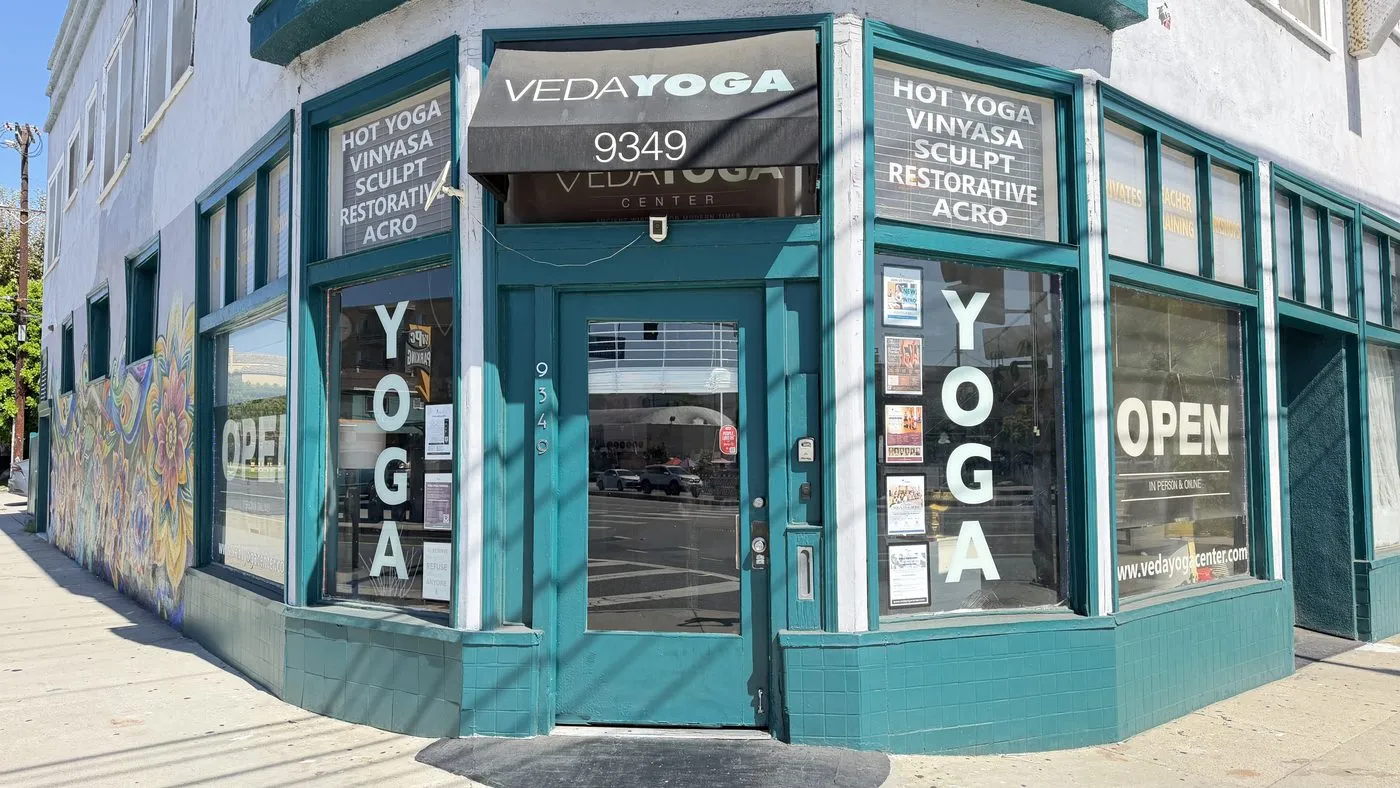
 Veda Yoga Culver City
A welcoming two-room studio with infrared heat, sculpt classes and immersion/teacher-training programs. Its own site and booking system call it Veda Yoga Venice, since it is on Venice Boulevard, but it is in Culver City; the second Veda room is on La Cienega.
Frequently asked questions
What should you wear to yoga class?
Something stretchy you can move in, and a top that stays where you put it when you fold forward. A t-shirt and leggings, joggers, or fitted shorts covers it. Yoga is practiced barefoot, so no shoes are needed.
What should you not wear to yoga?
Anything you will spend the class adjusting. Loose gym shorts, wide-armhole tanks, heavy jeans or non-stretch pants, zippers and hardware you have to lie on, dangly jewelry, and strong perfume in a small warm room.
Are shorts or leggings better for yoga?
Both work. Leggings are less to think about because they stay put in every shape. If you prefer shorts, choose fitted or lined ones, loose gym shorts ride up in wide-legged and reclined poses.
Is it better to do yoga barefoot or in socks?
Barefoot. Bare feet grip the mat, which is what keeps you steady in standing poses. Regular socks slide. If you want feet covered, use grip socks with rubber dots on the sole.
What shoes do you wear to yoga?
None. Shoes come off at the door or in the lobby of most studios. Wear whatever you like getting there, and leave them on the shoe rack.
Can you wear cotton to yoga?
It depends on the class. In a hot or fast class, cotton soaks through and stays wet and clingy. In a slow restorative, yin, or gentle class where you barely sweat, cotton is perfectly comfortable.
What do men wear to yoga?
A normal t-shirt with fitted shorts, lined shorts, or joggers. Loose gym shorts are the common mistake because they ride up in reclined and inverted shapes. Compression shorts underneath solve that entirely.
What should you wear to hot yoga?
As little as you're comfortable in, in synthetic fabric that dries fast. Fitted tank or sports bra, leggings or lined shorts. No layers, because you will be warm within minutes and will not want them.
Do you need special clothes for your first yoga class?
No. Yoga clothing is a preference, not a requirement. If you can move in it and it stays put when you bend over, it works for your first class and your hundredth.