Guide
Best Yoga Mats: How to Choose the Right One for You
Not a ranked list. Four decisions pick your mat, the first one settles most of the others, and the mat that suits a sweaty power class is the wrong mat for a knee that hurts.
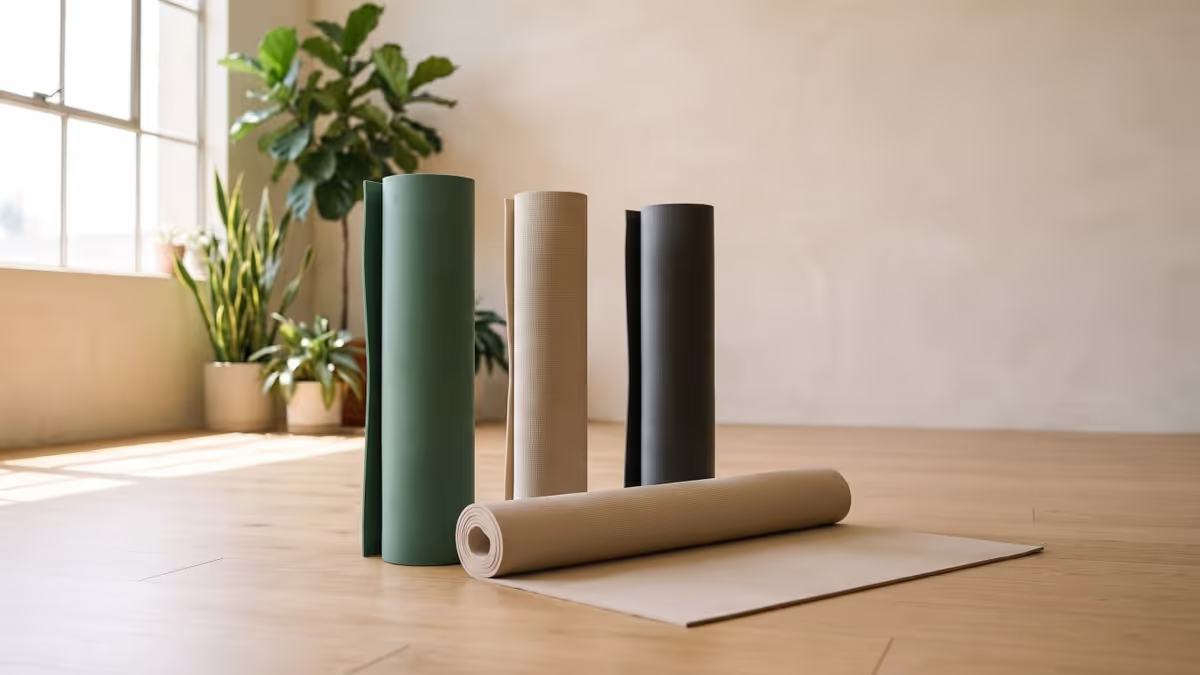
There is no best yoga mat, and any page that hands you one has quietly decided what kind of practice you have.
A mat that grips beautifully in a 105°F room is a mat you have to wash after every class. A mat that saves your knees in kneeling poses makes standing balances wobblier. A mat that lasts a decade is a mat you notice on the walk from the car.
So this page does something narrower and more useful: it gives you the four decisions that actually pick a mat, in the order they matter, and tells you what each answer costs you.
Where this page stops, and who to read instead
Worth saying before you read further. We have not put these mats through a test lab. Several sites have, and their rankings are useful. If what you want is a tested, ranked verdict, read one of those.
What we can give you is the thing those rankings mostly skip. We wrote the mat-care guide first, which meant working out how each material behaves when it gets wet, how long it takes to dry, and what destroys it. That turns out to be most of what decides whether you like a mat six months in. This page is that knowledge, pointed at the buying decision.
The four decisions
Everything else is preference. These four are the mat.
- Material. The first one, and it quietly makes the next three easier.
- Thickness. A trade between your joints and your balance.
- How it grips when you sweat. Not the same question as how it grips dry.
- Size. Only a real question if you are tall.
Answer them in that order.
Why the tested rankings disagree with each other
Read three of the tested roundups and you will get three different winners. That looks like a failure of testing. It is not. It is the four decisions above, showing up as disagreement.
A reviewer who practises hot vinyasa is grading wet grip, and will hand the win to an open-cell mat that a home practitioner would find needy and slow to dry. A reviewer testing on a hard studio floor is grading cushioning, and will rank a 6mm mat above a 4mm one that balances better. A reviewer who values lifespan picks the heaviest mat in the test.
None of them is wrong. They are answering different questions, and the question each one answered is usually stated somewhere in the piece, a long way from the headline.
So the useful way to read a ranking is backwards. Find the reviewer whose practice looks most like yours, then take their pick. A roundup’s overall winner is only your winner by coincidence.
Material decides more than you would think
Five materials cover almost every mat sold. Each one comes with a grip, a weight, a lifespan and a care burden attached, and you do not get to mix and match.
- PVC. Plastic-smooth, springy, light. The most durable material here and the most tolerant of cleaning, which is why almost every studio loaner is PVC. Grips well dry. Gets slippery when wet.
- TPE. Foam rather than plastic, often two-tone, the lightest of the five. Cheap and comfortable. Also the least durable, and heat or a washing machine will deform it permanently.
- Natural rubber. Heavy, and you feel it on the walk. The best dry grip of any common material, and it stays grippy damp. It is also the fussiest to clean, degrades in sunlight, and contains latex.
- Cork. A cork surface over a rubber backing. Naturally antimicrobial, and it gets grippier as your hands get damp. The backing is the weak point and the mat must never be soaked.
- Polyurethane. A thin PU layer bonded to a rubber base. The best wet grip available, which is why it dominates the premium end. In exchange it is open-cell, so it absorbs sweat, needs wiping after every single practice, and takes up to a day to dry properly.
Two of those consequences are worth pulling out, because they are what people actually complain about later.
Weight. Rubber and PU mats are heavy. If your mat lives in a car boot this does not matter at all. If you walk to class, it decides whether you keep going.
Care. The materials that grip best are the materials that need the most looking after. Rubber tolerates no vinegar and no alcohol. PU tolerates no scrubbing. Both take between 8 and 24 hours to dry after a proper clean, against 2 to 4 hours for PVC. The care guide has the full table.
Sweat is the real divide
This is the part almost nothing explains, and it is the single most useful thing on this page.
Mats do not all respond to moisture the same way. They respond in opposite directions.
- Closed-cell surfaces, meaning PVC and TPE, shed liquid. Sweat sits on top, and a film of sweat on a smooth surface is exactly as slippery as it sounds. These mats grip worse the harder you work.
- Open-cell surfaces, meaning PU and open natural rubber, take a little moisture in. That is the mechanism behind the “grippier when damp” feeling. These mats grip better the harder you work, up to a point.
Which is why a beginner who bought a perfectly good PVC mat and then took a hot class ends up sliding out of downward dog and blaming themselves. It was the mat, and it was working exactly as designed.
Two practical consequences:
- If you practise hot or you simply sweat a lot, you want open-cell, or you want a mat towel over whatever you own. A towel is the cheaper fix and it goes in the washing machine.
- If a brand-new open-cell mat feels slippery when dry, that is normal. Those surfaces break in over the first few weeks and grip properly once damp.
How to test a mat before you commit
Most of this is checkable in about a minute, in a shop or on the first practice of a mat you can still return.
Press a thumb into the surface and drag it. You are feeling for drag rather than slide. A grippy dry surface resists sideways pressure noticeably. A smooth one does not, and no amount of price fixes that.
Wet a fingertip and drag again in the same spot. This is the test that matters and almost nobody does it. On an open-cell mat the drag increases. On a closed-cell one it drops away. That difference is the hot-yoga answer, felt directly, in five seconds.
Kneel on it, on a hard floor. Not on the shop’s carpet. Kneecaps are the most common complaint and the only honest test is the surface you will actually practise on.
Stand on one leg. On a mat that is too soft you will feel your standing foot sinking and correcting. That is the cost of thickness, and it is much easier to notice before you own the mat.
Pick it up and hold it out at arm’s length for ten seconds. If that is annoying in a shop, it will be worse every week for a year on the walk to class.
Smell it. A new natural rubber mat smells strongly of rubber. That fades over a few weeks and is not a defect. A chemical or solvent smell on anything else is worth walking away from.
Thickness is a trade, not an upgrade
Thicker is not better. Thicker is a different set of compromises.
- 1.5mm to 3mm. Travel mats. They fold into a bag and weigh almost nothing. You will feel the floor through them, which is the price.
- 4mm to 5mm. The standard, and the right answer for most people for most practice. Enough padding for kneeling, enough firmness to balance on.
- 6mm and above. Cushioned. Genuinely kinder to knees, hips and spine on the floor. Also softer underfoot, so single-leg balances get harder, because your standing foot sinks slightly and keeps having to correct.
If your knees hurt in kneeling poses, try a folded blanket under them before you buy a thicker mat. It solves the two or three poses that are the problem without making every standing pose worse.
Size, if you are tall
The standard mat is roughly 68 inches long. That fits most people. Above about 5 foot 8, your hands or your feet start hanging off the end in the long poses, and a 71 or 74 inch mat is worth the small extra cost.
Width is a smaller question. The standard is 24 inches. A 26 or 28 inch mat is noticeably nicer in wide-legged standing poses and in anything with your arms out to the sides, at the cost of a bulkier roll.
Which mat, by what you actually do
The honest version of a recommendation list. Each of these has its own page with the detail.
Sweaty, hot, or power practice. You want open-cell. The lululemon Reversible is the common PU answer, and the Jade Harmony is the natural-rubber one. Both grip when wet. Both need real care.
Studio practice, and you want it to last. The Manduka range is built for this, and the choice inside the range is mostly about weight rather than surface. If it comes down to the PRO against a lululemon Align, that one is close enough to be worth every number side by side. Manduka is the one brand on this page that pays us a commission, which is why it is the one we hold to the comparison rather than to our own enthusiasm. The current price is on its PRO page.
Starting out, and not sure you will stick with it. A budget mat is a reasonable decision, not a compromise. The Retrospec Solana and Target’s All in Motion are the two most people land on. Both are fine to learn on. Both will show their limits in a hot room.
You practise at home on carpet or a hard floor. Thickness matters more than grip here, because nothing is going to make you slide on a home practice that does not raise a sweat.
You found the mat through the brand. That is a legitimate way to find things. The Alo mat is the usual case, and the honest question is whether the surface suits your practice, which is the same question as for everything above.
What a mat actually costs you
We are not going to quote prices, because they move and because the number on the tag is the least interesting part of this. The useful way to think about mat cost is cost per year of practice, and that is decided by care at least as much as by price.
Three rough tiers, and what each one is really buying:
- Budget. Usually TPE or thin PVC foam. Buys you a surface to learn on. Used a few times a week it tends to last months rather than years, and it will show its limits the first time you sweat properly on it.
- Mid. Usually a decent PVC or a basic rubber mat. This is where the value is for most people. Grips reliably, survives being cleaned, lasts years.
- Premium. Rubber or polyurethane, and what you are paying for is grip that holds when you are wet, plus a surface that does not wear through where your hands go. It is a real difference. It is not a difference in your practice.
The honest advice for a beginner is the middle tier, and the money saved goes on classes. The honest advice for someone practising four times a week in a heated room is the top tier, because you will wear out a cheaper mat and slide on it while you do.
And the thing that moves cost per year more than any of this: a mat wiped after every practice and dried flat outlasts an identical mat that gets rolled up damp, by years. That is free.
What we would not buy
- A mat with no material stated anywhere. If the listing will not tell you what it is made of, you cannot predict how it grips, how long it lasts, or how to clean it without wrecking it.
- A very thick foam mat for a standing practice. Sold as comfort, and it makes balancing meaningfully harder.
- Anything described only as “eco”. The word has no fixed meaning on a mat listing. Natural rubber, cork and TPE are all sold under it, and they behave completely differently.
- A second mat, when a mat towel would do. If your only complaint is grip when you sweat, a towel costs a fraction of a mat and solves it on the mat you already own.
The two-minute version
If you want one answer and you practise the way most people do: a 4mm to 5mm mat, in PVC if you barely sweat and in rubber or PU if you do, 71 inches long if you are tall. Wipe it after every practice and dry it flat.
That mat exists at every price point, and the difference between the cheap version and the expensive one is how many years it lasts, not whether it works.
When it does wear out, the care guide has the list of signs that mean replacement rather than another clean. And if you are still working out which room to take it to, the LA studio directory is the place to start.
Studios to explore
 Hot yoga
 Hot 8 Yoga Pasadena
A large, much-loved Old Town studio with a serene outdoor courtyard and classes from dawn to night.
Hot yoga Hot 8 Yoga Santa Monica
A polished hot-yoga studio with a deep class menu spanning yin, power, sculpt and barre fusion.
 Hot yoga
 Sweat Yoga Santa Monica
Candlelit, no-mirror hot yoga in downtown Santa Monica with a loyal, packed-room following.
 Hot yoga
 Veda Yoga Culver City
A welcoming two-room studio with infrared heat, sculpt classes and immersion/teacher-training programs. Its own site and booking system call it Veda Yoga Venice, since it is on Venice Boulevard, but it is in Culver City; the second Veda room is on La Cienega.
Hot yoga Sweat Yoga West Hollywood
The WeHo outpost of Sweat Yoga, with self-paced heated flows and a popular yin soundbath class.
Hot yoga Hot 8 Yoga Hollywood
The Hollywood branch of Hot 8, with clean facilities, easy parking and a full menu of heated classes.
Frequently asked questions
What thickness yoga mat should I get?
4mm to 5mm suits most people for most practice. Go to 6mm or more only if your knees or hips genuinely hurt on the floor, and accept that you will feel less stable in standing balances. Drop to 1.5mm to 3mm only for travel, where the mat has to fold into a bag and you are trading comfort for weight.
What is the best yoga mat material?
There is no single best one. Natural rubber grips best and weighs the most. Polyurethane grips best of all once damp and needs the most careful cleaning. PVC lasts longest and tolerates any cleaner. TPE is the lightest and the least durable. Cork suits sweaty hands and cannot be soaked. Choose by what your practice does to a mat, not by which material sounds most premium.
Are expensive yoga mats worth it?
Sometimes. An expensive mat buys grip that holds when you sweat and a surface that survives years rather than months. It does not buy you a better practice. If you are new and unsure you will stick with it, a mid-range mat is the honest answer, and the money is better spent on classes.
What is the best yoga mat for hot yoga?
An open-cell surface, meaning polyurethane or an open natural rubber, because those grip harder as they get wet. A closed-cell PVC mat gets more slippery the more you sweat on it. The alternative that works with any mat is a mat towel laid over the top, which absorbs the sweat and goes in the washing machine.
What is the best yoga mat for bad knees?
A thicker mat, 6mm or more, or a standard mat with a folded blanket under the knee for the poses that hurt. The blanket is the better first move, because it fixes the two poses that are the problem without making every standing pose wobblier.
How long should a yoga mat last?
A cheap foam mat used a few times a week tends to last months rather than years. A quality PVC or rubber mat, wiped after each practice and dried flat, can last five years or more. Care matters more than price here. The single fastest way to kill any mat is rolling it up damp.
Is a 6mm mat too thick for yoga?
Not too thick, but it is a trade. The extra cushioning that saves your knees also lets your foot sink, which makes single-leg balances noticeably harder. If most of your practice is standing, 6mm will fight you. If most of it is on the floor, it will not.
What size yoga mat do I need?
The standard mat is about 68 inches long. If you are taller than roughly 5 foot 8, your hands or feet will hang off in some poses, and a 71 or 74 inch mat is worth the small extra cost. Width matters less, but a wider mat helps in wide-legged standing poses and in anything where your arms go out to the sides.