Los Angeles · Yoga News
A New Trial Found App-Delivered Yoga Beat Exercise on Depressive Symptoms — With Big Caveats
In a three-arm trial of 75 employees, the yoga group improved on depressive symptoms against control (β=−3.67) while the exercise group did not. Encouraging — and far too small to settle anything.
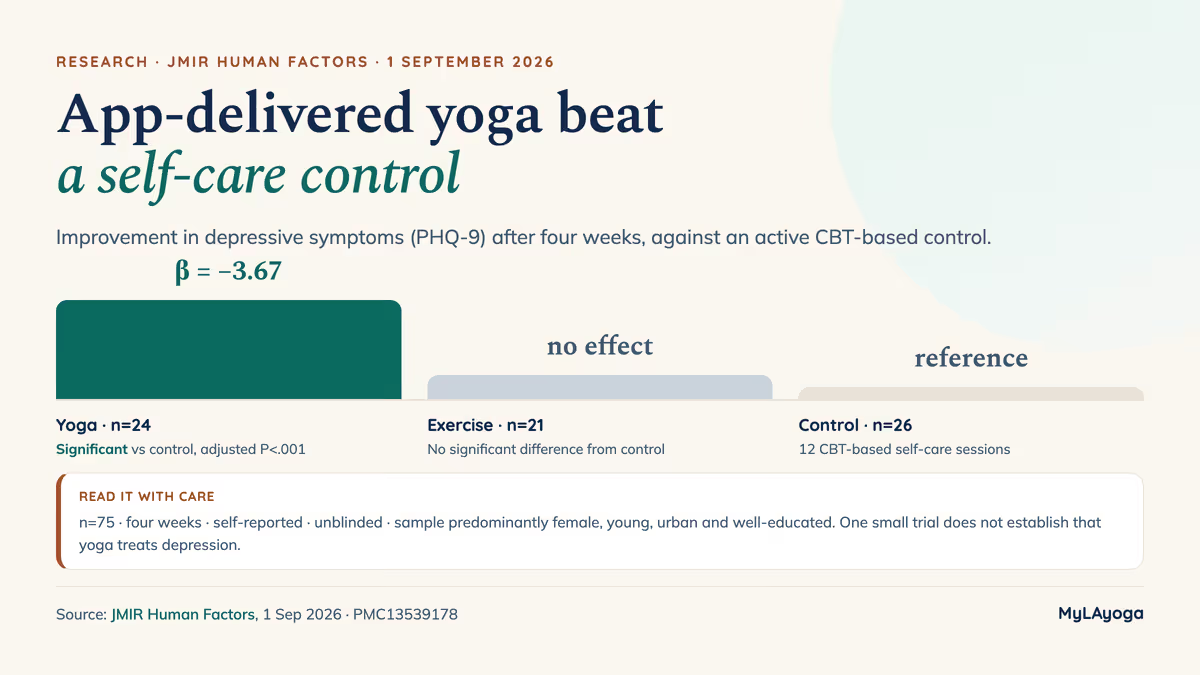
A randomized controlled trial published in JMIR Human Factors on 1 September 2026 put three four-week, app-delivered programmes head to head in a group of office employees, and the yoga arm was the only one to beat the control on depressive symptoms.
What the study actually did
Researchers in the Republic of Korea randomised 75 employees into three parallel arms, 71 of whom finished:
- Yoga (n=24) — 12 sessions, three a week for four weeks
- Adaptive moderate-intensity exercise (n=21) — 12 sessions of 50 minutes, three a week for four weeks
- Control (n=26) — 12 CBT-based self-care education sessions on the same schedule
The primary outcomes were the Perceived Stress Scale and the PHQ-9, a standard nine-item depression questionnaire.
What it found
On depressive symptoms, the yoga group showed “significantly greater improvement … compared to the control group at 4-week follow-up (β=−3.67; adjusted P<.001).” The exercise group showed no significant difference from control.
On stress, nothing separated the groups: the group-by-time interaction was not significant (P=.29), though every arm improved over time — which is roughly what you would expect when people are being paid attention to for a month.
Why you should hold it loosely
The authors are unusually frank about the limits, and they matter more than the headline:
- It is small. Seventy-five people, powered only to detect large effects.
- It is short. Twelve sessions over four weeks says nothing about whether the benefit lasts.
- It is self-reported. PHQ-9 and PSS are questionnaires, and the trial was unblinded — participants knew which arm they were in.
- The sample is narrow: predominantly female, young, urban and well-educated, with strict exclusion criteria that ruled out employees with comorbid conditions.
- The control was active, not a do-nothing group, which the authors note may have diluted differences — this makes the yoga result harder to achieve, not easier, but it also means “yoga beat exercise” is not the right reading. Exercise simply failed to separate from a decent control in a small sample.
One study of 75 people does not establish that yoga treats depression, and nobody should swap a treatment plan on the strength of it. What it does add is one more reasonably-designed data point that a short, structured, remotely-delivered yoga programme is worth studying properly at scale.
The practical version
If the appeal here is “three short sessions a week, at home, no studio,” that is a thing you can simply try — and in Los Angeles it does not have to cost anything. Grand Park runs free outdoor classes twice a week at midday, and our studio directory flags the rooms that livestream. If you are dealing with depression, the useful move is talking to a clinician; yoga is a reasonable thing to add, not a reason to delay that.
Sources
Want your studio in the directory? Add your studio.