Guide
How to Clean a Yoga Mat (Without Ruining It)
Your mat smells, feels slick, or looks grubby. The fix depends almost entirely on what it's made of, and the wrong cleaner will cost you the grip permanently. Here's the method for each material.
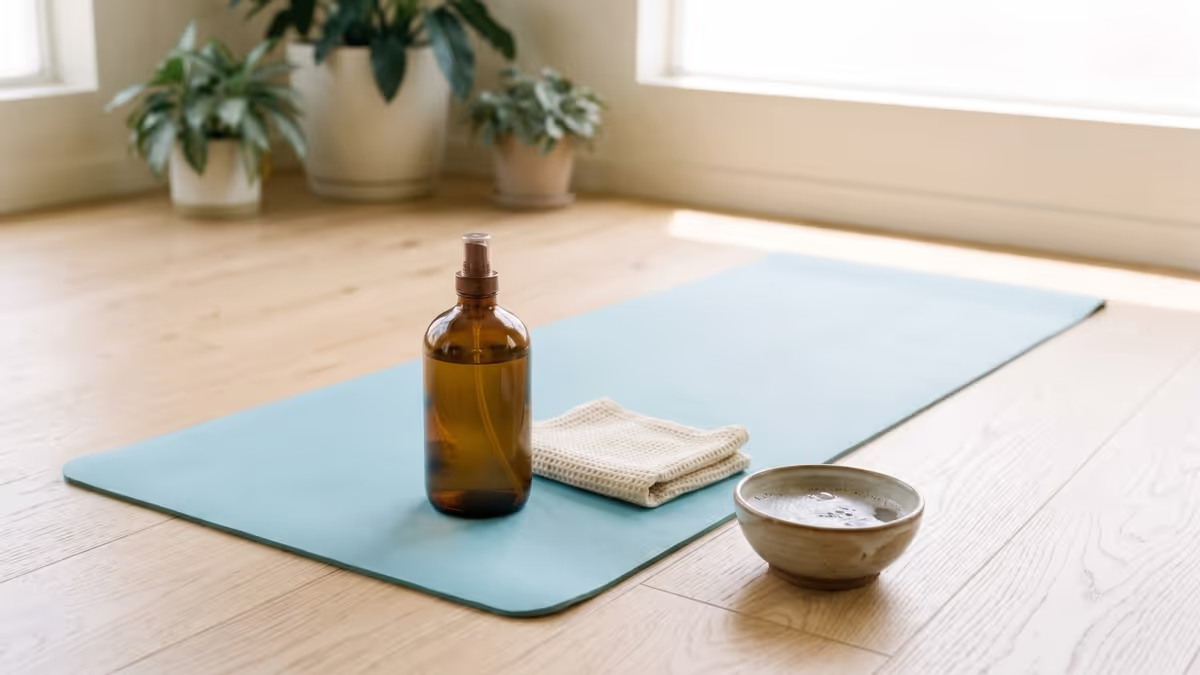
To clean a yoga mat: wipe both sides with a soft cloth wrung out in plain water, lay it flat, and let it dry all the way through before you roll it up. That’s the whole method for most mats most of the time, and doing it after every practice matters more than any occasional deep clean.
Two things change the details: what the mat is made of, and how much you sweat on it. The material matters more than people expect. A cleaner that’s perfectly fine on a cheap PVC mat will strip the grip off a natural rubber one and never give it back. So before you reach for anything stronger than water, spend thirty seconds working out what you actually own.
First, work out what your mat is made of
Most people don’t know, and most mats don’t say. You can figure it out by hand.
Drip a few drops of water on the surface and wait ten seconds.
- The water beads and sits there → you have a closed-cell surface. Nothing soaks in, which means nothing soaks in to clean out either. Wiping the top is genuinely enough. Most PVC mats and most cork mats behave this way.
- The water darkens the spot and sinks in → open-cell. The surface is slightly porous, which is what gives it that grippy, almost tacky feel when you’re sweaty. It also means sweat goes in, so it needs more thorough cleaning and much longer drying. Most PU-topped mats do this.
Then look at a cut edge and weigh the mat in one hand.
- PVC, plastic-smooth, springy, lightweight, edges look like uniform foam. Often the cheapest mats and most studio loaners. Water beads. Very durable and very tolerant of cleaning.
- TPE. Feels like foam rather than plastic, noticeably light, often two-tone with a different color layer underneath. Softer and less durable than PVC. Heat and machines deform it.
- Natural rubber, heavy. Distinctly heavy. A rubber mat you carry to class is the one you notice on the walk. It has a faint rubbery smell when new, and the surface has a slight drag. This is the material with the most ways to wreck it.
- Cork. Obvious on sight, cork top, almost always a rubber backing you can see at the edge. Water beads on the cork itself. The backing is the vulnerable part.
- PU (polyurethane), a smooth top layer bonded to a rubber base. Feels slightly grippy-sticky when damp rather than slippery. This is what Liforme mats and the lululemon Reversible mats use on their grippy side, and the material that essential oils destroy fastest.
If you truly can’t tell: treat it as the most fragile option. Damp cloth, plain water, wrung out until it’s barely damp, wipe, dry flat. That method is safe on all five materials and will never make anything worse. You can always escalate later.
The everyday wipe-down (60 seconds after practice)
This is the part that actually keeps a mat alive, and it’s the part people skip in favor of an occasional heroic deep clean. It’s backwards. Sweat and skin oils sitting on a mat for a week are what cause the smell and the loss of grip. Wipe them off while they’re fresh and you barely ever need to deep clean.
The universal method, safe on every material:
- Take a soft cloth or microfiber towel and dampen it with plain water.
- Wring it out hard. It should feel damp, not wet. No drips.
- Wipe the whole top surface, then flip and do the underside where it picked up floor grit.
- Hang it over a chair back or a door for twenty minutes before you roll it.
If your hands and feet were greasy, or the mat feels tacky rather than clean, add one drop of mild dish soap to a cup of water. A trace, not a squeeze. Then wipe a second time with a fresh cloth and clean water to take the soap back off. That second pass is not optional. See below for why.
If you want a spray
You don’t need one. A damp cloth does the same job, and the bottle is mostly a convenience. If you like having one in the mat bag, the safe universal fill is plain water; for a mat that needs a little more, water with one drop of mild dish soap per cup.
Two rules whatever’s in it:
- Spray the cloth, not the mat. Spraying the mat directly soaks the edges and pushes liquid into seams and backings, which is exactly what rubber and cork can’t take.
- If there was soap in the bottle, follow with a plain-water pass.
Where the usual recipes go wrong:
- Vinegar, fine heavily diluted on PVC and TPE. Not on natural rubber, cork or PU.
- Essential oils. Skip them entirely. Reasons below.
- Baking soda. It’s an abrasive. It scuffs an open-cell PU top and lodges in cork. Keep it for the laundry.
- Rubbing alcohol and alcohol wipes, they dry rubber out and crack it.
One note on the word disinfect, since most sprays are sold on it. The ingredients strong enough to earn that word (alcohol, bleach) are the same ones that wreck rubber, cork and PU. On a mat only you use, washing it regularly and drying it fully is the sensible trade, and nothing on this page will sterilise anything.
The deep clean, material by material
Deep cleaning is a monthly-ish job, not a weekly one. Here’s what each material can take.
| Material | Everyday wipe | Deep clean | Vinegar safe? | Machine wash? | Submerge? | Dry time |
|---|---|---|---|---|---|---|
| PVC (closed-cell) | Damp cloth, water | Warm water + a drop of mild dish soap, cloth or soft sponge, then rinse-wipe | Yes, heavily diluted | Sometimes: cold, gentle, no spin, only if the maker says so | Brief bath OK | 2–4 hours flat |
| TPE | Damp cloth, water | Same as PVC but gentler pressure; no hot water | Yes, heavily diluted | No: heat and agitation deform it permanently | Quick rinse only, don’t soak | 3–5 hours flat |
| Natural rubber | Damp cloth, water only | Cool water, cloth, at most a trace of mild soap; work in sections and rinse-wipe each one | No | No | No, it absorbs and swells | 8–24 hours flat, out of sun |
| Cork (rubber-backed) | Damp cloth, wipe with the grain | Cool water and a cloth. That’s it. Cork doesn’t want cleaner | No | No | No, the backing swells and delaminates | 6–12 hours flat |
| PU (open-cell top) | Damp cloth, water only, after every single practice | Cool water, soft cloth, small circles, then a plain-water pass; never scrub | No | No | No | 12–24 hours flat |
Two materials deserve extra words, because they’re where most mats die.
Natural rubber
Rubber is the heavyweight, and it’s chemically sensitive in a way the plastics aren’t. Alcohol, vinegar, citrus and strong detergent all dry it out; the surface goes chalky, then it starts to crumble at the edges. It also absorbs water rather than shedding it, so a rubber mat that gets soaked stays wet inside for days. Work in sections with a barely-damp cloth, rinse each section by wiping again with clean water, and give it a full day flat before it goes near a strap.
Cork
Cork looks bombproof and mostly is, on top. The problem is underneath: nearly every cork mat is cork bonded to a rubber base, and water that gets between those two layers is what causes bubbling and peeling. So never soak one, never stand it in a shower, and don’t drench the edges. Wipe with the grain of the cork rather than across it, and if it seems dull afterwards, that’s just moisture. It comes back as it dries.
What actually ruins a mat
Most mats aren’t worn out. They’re damaged by cleaning.
Soap residue. The single most common one. Soap left on the surface dries into a thin film, and the moment your body heat and a bit of sweat hit it, that film goes slick. This is a real safety issue, not a comfort issue. The first place you’ll notice is your hands sliding forward in downward-facing dog, which is exactly where you don’t want a surprise. Use less soap than you think, and always follow with a plain-water pass.
Essential oils. Tea tree, lavender, eucalyptus. Most mat-cleaning recipes online call for a few drops, and it’s bad advice for two of the five materials here. Oils sit on the surface rather than evaporating, and on natural rubber and PU they slowly break down the grip layer. The mat gets progressively slicker and there’s no way to reverse it. If you want your mat to smell like something, clean it properly and let it dry. That’s what removes the smell you’re covering up.
Direct sunlight. Sun is not a dryer. UV degrades rubber, TPE and PU, making them brittle and faded. Dry the mat flat, indoors, or somewhere shaded with moving air. A balcony in the shade is fine; a driveway in August is not.
Submerging cork or rubber. Both absorb. Both swell. Cork delaminates from its backing, rubber stays wet inside and starts to smell from within, which is the one smell you can’t clean out.
Machine-washing TPE. The combination of heat, spin and agitation stretches and crushes the foam. It comes out wavy and never lies flat again.
Alcohol on rubber. Rubbing alcohol, alcohol wipes, hand-sanitizer residue. It dries the surface out and cracks it. Skip it.
Drying: the step everyone rushes
“Dry completely” is useless advice on its own, so here are the times to expect. Lay the mat flat or hang it fully open, not rolled and not folded, somewhere with air moving.
- Closed-cell PVC, 2 to 4 hours. Genuinely fast, because nothing went in.
- TPE, 3 to 5 hours.
- Cork, 6 to 12 hours. The cork surface looks dry long before the backing is.
- Natural rubber, 8 to 24 hours after a deep clean. It holds water.
- Open-cell PU, 12 to 24 hours after a deep clean. Longest of the lot.
Rolling a mat that’s still damp is how mildew starts, and mildew in a mat is unrecoverable. There’s no cleaner that fixes it, because the growth is inside the material, not on it. If you have to travel with a mat you just cleaned, carry it open over your arm rather than rolled in a bag.
One more: put it away rolled, not folded. Folds crease permanently in TPE and PU and the crease becomes a weak line that eventually splits.
How often, honestly
The one-size answer everybody gives, “wipe after each use, deep clean monthly”, is right for exactly one kind of practitioner. Here are three real cadences.
Gentle home practice, a few times a week, barely sweating. Wipe down after each session. Deep clean about once a month. If you’re building a short daily practice routine at home on your own floor, this is you, and the mat will last years.
Regular studio classes, two to four a week, some sweat. Wipe after every class, without exception. Studio floors add grit that a home floor doesn’t. Deep clean every two weeks. Keep the wipe cloth in your mat bag so it happens before the mat gets rolled.
Hot yoga or heavy-sweat flow. Wipe after every single practice, and deep clean weekly. A hot class puts more sweat on a mat in ninety minutes than a gentle home week does, and sweat is the thing that breaks grip down. If you’re weighing which end of that spectrum you’re on, our comparison of hot yoga and vinyasa lays out how much sweat each actually involves.
The honest shortcut for hot practice: use a mat towel over the mat. It absorbs most of the sweat, it goes in the washing machine, and it means the mat itself needs far less intervention. It’s the single best thing you can do for a mat’s lifespan in a hot room.
Still slippery, still smells, or flaking?
Three problems, three different causes.
Still slippery after cleaning
It’s soap. Almost always. Wipe the whole mat again with plain water and a clean cloth, changing the water two or three times, and let it dry fully. If it’s a brand-new open-cell PU mat and it’s slippery when dry but grippy when damp, that isn’t a cleaning problem at all. Those mats are designed to grip once there’s a little moisture, and they break in over the first few weeks of use.
Still smells
Sniff it and place the smell. A sour smell is trapped sweat, usually in an open-cell surface that got rolled up damp. It needs a proper deep clean and a long, patient, flat dry, and it can take two rounds. A rubbery, chemical smell on a new natural rubber mat is off-gassing and is normal; it fades over a few weeks on its own, faster if you leave the mat unrolled in a ventilated room. A musty smell is mildew, and that one doesn’t come out.
Flaking, crumbling, or shedding color onto your hands
This is material breakdown, not dirt. The surface layer has failed. Cleaning will make it worse, because you’re abrading a layer that’s already coming apart. The honest answer is that the mat is finished, and no cleaner will bring it back.
If you use a studio mat
Loaner mats are a fine way to try a class before you buy anything. A few things worth knowing.
Studios wipe their loaners between classes, and they’re wiping a lot of mats quickly. That’s why loaners tend to be plain closed-cell PVC rather than anything fancier: PVC is the one material that survives being cleaned constantly. It’s a sensible choice on the studio’s part, not a corner cut.
If you use loaners regularly, bring your own mat towel and lay it over the top. It solves the hygiene question entirely, it gives you a better grip surface than a well-used loaner, and it costs a fraction of a mat. Studios that run heated classes usually rent towels too, and it’s normal to ask at the desk.
You can check what a specific studio provides (mats, towels, showers), on its page in our studio directory. It’s worth a look before your first class at a hot studio in particular, where you’ll want a towel either way.
When to replace it instead
No amount of cleaning fixes a worn-out mat, and at some point the maintenance question is really a replacement question. Replace it when:
- The surface flakes or leaves color on your palms.
- There are permanently thin, shiny patches under where your hands and feet land. Grip is gone there and it will not return.
- It won’t lie flat, waves, curled edges, creases that stay.
- It’s mildewed. Not salvageable.
- It splits or tears along a fold line.
A mat that gets wiped after every use and dried properly lasts a lot longer than one that doesn’t. If you’ve decided yours is done and you’re picking a new one, our guide to choosing a mat walks through the four decisions that pick one, and the equipment checklist covers everything else a beginner needs. This guide is only about keeping what you already own alive.
Studios to explore
 Hot yoga
 Sweat Yoga Santa Monica
Candlelit, no-mirror hot yoga in downtown Santa Monica with a loyal, packed-room following.
 Hot yoga
 Hot 8 Yoga Pasadena
A large, much-loved Old Town studio with a serene outdoor courtyard and classes from dawn to night.
CorePower Yoga Downtown LA
A central branch of the national chain with reliably heated classes and easy drop-in scheduling.
 Hot yoga
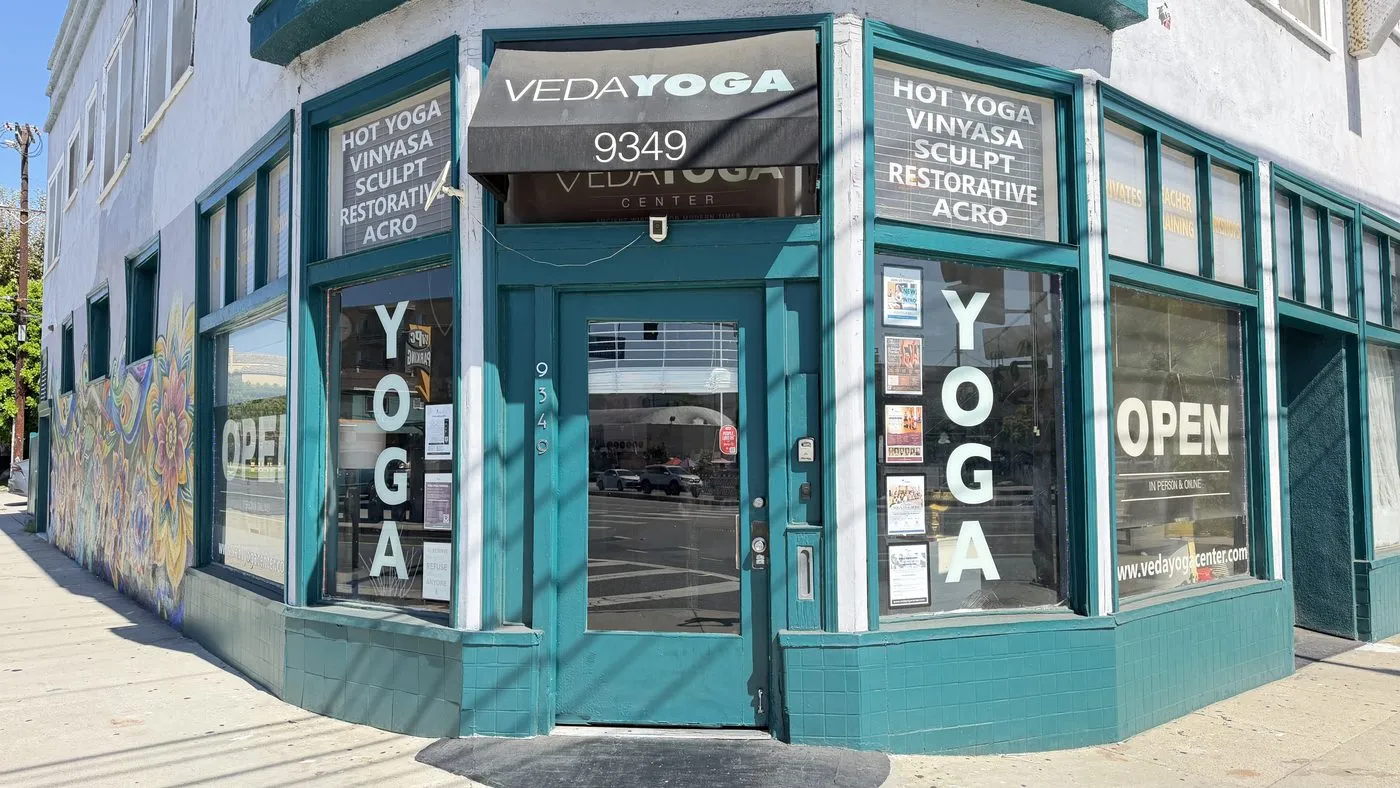
 Veda Yoga Culver City
A welcoming two-room studio with infrared heat, sculpt classes and immersion/teacher-training programs. Its own site and booking system call it Veda Yoga Venice, since it is on Venice Boulevard, but it is in Culver City; the second Veda room is on La Cienega.
Boheme Yoga
A tidy DTLA studio with hot classes, live-music sessions and restorative practice in the Historic Core.
Hot yoga Hot 8 Yoga Santa Monica
A polished hot-yoga studio with a deep class menu spanning yin, power, sculpt and barre fusion.
Frequently asked questions
How often should you clean your yoga mat?
Wipe it down after every practice, that takes under a minute and is the part that matters. A deep clean is needed roughly monthly for a gentle home practice, every two weeks for regular studio classes, and weekly if you sweat heavily or do hot yoga.
Can you put a yoga mat in the washing machine?
Usually no. Closed-cell PVC mats and cotton or jute mat towels are the main exceptions, and even then only on cold and gentle. A machine will deform TPE, tear the foam layer off a PU mat, and force water into natural rubber and cork, which then stay wet inside. When in doubt, wash by hand.
Can I use vinegar on a yoga mat?
On PVC and TPE a very dilute vinegar solution is fine. Avoid it on natural rubber, cork and PU, the acidity dries rubber out over time and can lift the top layer on a PU mat. For those three, plain water is the safe answer, with a trace of mild dish soap if you need more.
Why is my yoga mat slippery after cleaning?
Almost always leftover soap. A thin film sits on the surface, and body heat and a little sweat turn it slick. Rinse the mat again with plain water and a clean cloth, changing the water a few times, then dry it fully. It should come back.
Why does my yoga mat smell?
Either sweat that soaked into an open-cell surface and never dried, or the natural rubber smell on a new mat, which fades on its own over a few weeks. Trapped sweat needs a proper deep clean and a long, flat dry. If the smell is musty rather than sour, the mat was rolled up damp.
Can I use disinfectant wipes on a yoga mat?
Not on natural rubber, cork or PU. The alcohol and bleach that make a wipe strong are the same things that dry rubber out, crack it, and lift the top layer on a PU mat. PVC tolerates them better, but even there a plain damp cloth after every practice does more for the mat than an occasional wipe does. Wash regularly and dry fully rather than reaching for something stronger.
Can you use baking soda on a yoga mat?
Better not to. Baking soda is a mild abrasive, so it scuffs an open-cell PU surface and gets stuck in the pores of cork. If a mat smells, the cause is trapped sweat or a damp roll-up, and the fix is a proper wash and a long flat dry, not a scouring powder.
How do you clean a cork yoga mat?
Water and a cloth, wrung out hard, and nothing else. Cork is naturally water-resistant on the surface but the backing underneath is usually rubber, so never soak it or put it in a machine. Wipe with the grain, dry flat, and let it go longer than you think it needs.